Thomas Nast's Christmas drawings for the human race — Story, Setting & Ideas

(0 User reviews)   1125
In Category - Design Photography
Nast, Thomas, 1840-1902 [Illustrator] Project Gutenberg 2023 Not confirmed
Christmas -- Pictorial works; Christmas in art Readers of public-domain and historical texts
Project Gutenberg digital edition en

Edition facts

Words 4,676
Reading time 21 min
Text sections 7

This digital edition of Thomas Nast's Christmas drawings for the human race — Story, Setting & Ideas is described by source-level measurements including 4,676 words, 21 min estimated reading time, and 7 detected text sections.

The text analysis averages about 16.6 words per sentence, while the detected sections provide another way to judge how the source is divided.

Project Gutenberg metadata also associates the work with “Christmas -- Pictorial works,” connecting these edition facts with the source record’s subject description.

This 1889 collection of Thomas Nast's Christmas illustrations reveals a Santa Claus rooted in 19th-century American domesticity and political satire, with visual jokes that blend holiday cheer with contemporary commentary.
Share
Editorial Edition Score 4.5/5

Calculated from edition completeness, EPUB availability, text structure and catalogue metadata. Not a user rating.

How this score is calculated
  • Description quality20 pts
  • Title & short description10 pts
  • Source metadata20 pts
  • Text length15 pts
  • Chapters / structure15 pts
  • EPUB file integrity20 pts

Total of 100 points, scaled to a 2.5-5.0 range. Editions with an empty description or a missing EPUB file are not scored.

Edition quality

Read the Text

Transcriber’s Note: Italics are enclosed in _underscores_. Additional notes will be found near the end of this ebook.

NEW YORK HARPER & BROTHERS PRINTERS & PUBLISHERS · FRANKLIN SQUARE M DCCC XC

This volume of Mr. Nast’s “Christmas Drawings” is the first collection of his works which has been published. The pictures are well called “Drawings for the Human Race,” because they appeal to the sympathy of no particular religious denomination or political party, but to the universal delight in the happiest of holidays, consecrated by the loftiest associations and endeared by the tenderest domestic traditions. Christmas is the holiday of all; but it is especially the Children’s day. The grotesque and airy fancies of childhood which cling about Santa Claus, as the good genius of Christmas, are reproduced upon these pages, in delightfully imaginative reality by the sympathetic touch of the artist, so that the book is an overflowing feast of true Christmas cheer.

Mr. Nast’s hand, when dealing with current topics of the time, tips the flashing shafts of wit with morality; with relentless humor puts cunning pretence in the pillory; and exposes public wrong to the fatal merriment which laughs it away. But the artist’s hand is never happier than when, with the lambent light of the same humor, it irradiates the play of domestic affection, and makes the home circle gay. It is the bluff, honest Santa Claus of “The Night before Christmas;” the Santa Claus of the reindeer and the sleigh, alighting on the snowy roof, and descending the chimney with his wondrous pack of treasures; the Santa Claus of unsuspecting childhood, and the Mother Goose of undoubting infancy, to whom these pages introduce us. There is no child who cannot understand them, no parent who cannot enjoy them. Mr. Nast is fairly without a rival in this kind. His Santa Claus is old Father Christmas himself, and his welcome will be as general and as hearty as that which salutes the crammed and enchanted stocking on Christmas morning.

STOCKING OF CONTENTS.

1. “ANOTHER STOCKING TO FILL.”

2. FIRST-PRIZE CHRISTMAS-CARD--BEING FARTHEST FROM THE SUBJECT.

4. STOCKING OF CONTENTS.

7. SANTA CLAUS’S ROUTE.

8. DARNING THE STOCKING.

9. CHRISTMAS FURLOUGH.

10. “WHO SAID ANYTHING ABOUT CHRISTMAS DINNER?”

11. CUTTING MISTLETOE IN THE SOUTH.

12. CHRISTMAS GREENS.

14. SANTA CLAUS’S MAIL.

15. “HELLO! SANTA CLAUS!”

16. “HELLO! LITTLE ONE!”

17. “’TWAS THE NIGHT BEFORE CHRISTMAS.”

18. SANTA CLAUS AND HIS WORKS.

19. MESSAGES AND LISTS FOR SANTA CLAUS.

21. CHRISTMAS FANCIES.

22. “HE PRAYED, ‘AND LET SANTA CLAUS FILL MY STOCKINGS JUST AS FULL AS HE CAN. AMEN.’”

24. “SANTA CLAUS CAN’T SAY THAT I’VE FORGOTTEN ANYTHING.”

25. THE WATCH ON CHRISTMAS EVE.

26. CHRISTMAS EVE.--SANTA CLAUS WAITING FOR THE CHILDREN TO GET TO SLEEP.

27. SEEING SANTA CLAUS.

29. “’TWAS THE NIGHT BEFORE CHRISTMAS, AND ALL THROUGH THE HOUSE NOT A CREATURE WAS STIRRING, _not even a Mouse_.”

30. CHRISTMAS STATION.

31. THE SAME OLD CHRISTMAS STORY OVER AGAIN.

32. “HERE WE ARE AGAIN!”

33. PEACE AND GOOD WILL.

34. THE COMING OF SANTA CLAUS.

35. CHRISTMAS EVE.--OLD FACES FOR YOUNG HEARTS.

37. A CHRISTMAS SKETCH.

40. THE SHRINE OF ST. NICHOLAS.

41. “LITTLE BO-PEEP FELL FAST ASLEEP AND DREAMPT--”

42. SEE! THE CHRISTMAS PLUM PUDDING.

43. “COME NOW, SANTA CLAUS, I’S READY.”

45. LITTLE JACK HORNER.

46. CHRISTMAS FLIRTATION.

47. THE DOMESTIC EXPRESS.

48. OLD MOTHER GOOSE MELODIES.

50. THE CRUSTY OLD BACHELOR WHO IS BOUND TO HAVE SOMETHING IN HIS STOCKING.

51. A CHRISTMAS STORY.

53. MERRY OLD SANTA CLAUS.

54. SANTA CLAUS’S REBUKE.

55. THE CHRIST CHILD.

56. THE DEAR LITTLE BOY THAT THOUGHT CHRISTMAS CAME OFTENER.

58. “FOR HE’S A JOLLY GOOD FELLOW, SO SAY WE ALL OF US.”

59. SANTA CLAUS’S TOOL-BOX.

60. CHRISTMAS IN CAMP.

61. CHRISTMAS SUPPLEMENT TO “HARPER’S WEEKLY.”

62. A MERRY CHRISTMAS.

63. “MERRY CHRISTMAS TO ALL, AND TO ALL A GOOD-NIGHT.”

64. “WISHING YOU A MERRY CHRISTMAS AND A HAPPY NEW YEAR.”

65. ’TWAS THE NIGHT AFTER CHRISTMAS.

Punctuation, hyphenation, and spelling were made consistent when a predominant preference was found in the original book; otherwise they were not changed.

Simple typographical errors were corrected; unbalanced quotation marks were remedied when the change was obvious, and otherwise left unbalanced.

This book does not have page numbers.

Transcriber added sequence numbers to the entries in the Table of Contents.

When illustrations did not have captions, Transcriber added them by using part of the corresponding entry in the Table of Contents, or text within the illustrations themselves.

Transcriber added words and phrases that were within some of the illustrations to their captions, and enclosed them in parentheses to indicate they were not parts of the original captions.

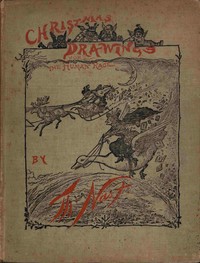
The first illustration is the cover.

The original book was autographed. A copy of that is included in this eBook as the second illustration.

Thomas Nast's Christmas Drawings for the Human Race (1889) is a collection of illustrations that pairs Santa Claus with pointed social and political humor. The opening image, labeled 'First-Prize Christmas-Card—Being Farthest from the Subject,' depicts a summer scene with mosquitoes, flies, and a 'Merry 4th of July' greeting—a visual punchline that sets the tone for Nast's irreverent approach. The publisher's note emphasizes that these drawings 'appeal to the sympathy of no particular religious denomination or political party,' yet the images themselves often engage with current events, using Santa as a vehicle for satire. This tension between universal holiday sentiment and topical wit defines the collection.

Satirical Stockings and Summer Santas

The collection's table of contents is titled 'Stocking of Contents,' a pun that signals Nast's playful treatment of the holiday. The first image, as noted, is a deliberate joke about a Christmas card that is 'farthest from the subject'—set in June, July, August, with mosquitoes and flies. This self-aware humor extends throughout the volume. Nast's Santa is not confined to winter; he appears in contexts that mock commercialism, politics, and social pretensions. The publisher's note describes Nast's hand as 'tipping the flashing shafts of wit with morality,' suggesting that even his most whimsical drawings carry a critical edge. Readers should expect visual gags that reward close attention to detail, such as the juxtaposition of holiday symbols with unexpected settings.

Domestic Cheer and Political Barbs

While the catalog subjects list 'Christmas in art' and 'Christmas — Pictorial works,' the excerpts reveal a broader range. The publisher's note explicitly states that Nast's drawings 'expose public wrong to the fatal merriment which laughs it away,' indicating that political satire is integral to the collection. However, the same note also highlights 'the play of domestic affection' and 'the home circle gay.' This dual focus means that images of Santa with children coexist with caricatures of public figures. Without seeing the full illustrations, it is impossible to identify specific targets, but the text makes clear that Nast used Christmas imagery to comment on contemporary issues. The volume thus functions as both a holiday keepsake and a historical document of 1880s American humor.

The Artist's Hand and the Reader's Eye

The publisher's note repeatedly emphasizes Nast's skill: 'Mr. Nast is fairly without a rival in this kind.' His Santa is described as 'old Father Christmas himself,' a figure rooted in Clement Clarke Moore's 'The Night before Christmas' yet rendered with Nast's distinctive style. The note also mentions 'the grotesque and airy fancies of childhood' and 'the Mother Goose of undoubting infancy,' suggesting that the drawings blend realism with fantasy. For modern readers, the value lies in observing how Nast constructs his visual narratives—through composition, expression, and symbolic detail. The transcriber's note advises that larger versions of illustrations are available, encouraging careful examination. This is not a book to skim; its humor and commentary unfold through the interplay of image and caption.

Nast's Christmas Drawings rewards readers who approach it as a visual text rather than a mere holiday gift book. Pay attention to the captions and the placement of figures; many jokes rely on contrast between the Christmas setting and the subject matter. The collection offers a window into late-19th-century American culture, where Santa Claus could be both a symbol of domestic warmth and a tool for satire. Let the images guide your reading, and consider how Nast's blend of sentiment and wit might challenge contemporary expectations of holiday art.

Leafing through Nast’s Santa—all warm hearths and sly political winks—I found myself thinking of quiet handwork, of images built slowly, layer upon layer. There is a similar patience in Bromoil printing and bromoil transfer — A Reader’s Guide, where each print asks for a gentle, deliberate touch. Both feel like crafts of a softer century, preserving small wonders in ink.

There are no reviews for this eBook.

0
0 out of 5 (0 User reviews )

Add a Review

Your Rating *
There are no comments for this eBook.

Reader reflection

Record your reading impressions

A brief reflection can help important ideas stay with you longer.

Your progress 0 / 10
1

What is your current status with this title?

2

How much did you enjoy the reading experience?

3

Would you pass this book on to a friend?

4

How easy was the book to follow?

Related eBooks