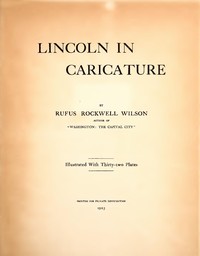
Rufus Rockwell Wilson opens Lincoln in Caricature by asserting that Lincoln was "the most bitterly assailed and savagely cartooned public man of his time," a claim he supports by tracing the President's depiction in American and British periodicals from 1860 to 1865. The book reproduces thirty-two plates from sources such as Harper's Weekly, Vanity Fair, and London Punch, arranging them chronologically with explanatory notes. Wilson emphasizes that these cartoons serve as "human documents" that reflect the shifting sentiments of the Northern public and the hostile stance of Great Britain. The opening establishes the work's dual purpose: to preserve visual artifacts and to clarify their historical context for readers whose memory of the Civil War era may have faded.
The Tightrope of 1860
The earliest cartoon in the collection, "Lincoln à la Blondin" (August 1860), draws on a recent sensation: the French acrobat Blondin crossing Niagara Falls on a tightrope. Wilson notes that the image was "suggested by Blondin's crossing of Niagara on a tight rope with a man on his back" and ties it to Lincoln's first presidential campaign. The cartoon recalls an incident from Lincoln's youth in 1830, when he built a log house with his father and John Hanks near Decatur, Illinois. This early plate sets a pattern: each cartoon is anchored to a specific news event or biographical detail, with Wilson providing the political or personal backstory needed to decode the satire. Readers should note how the commentary bridges the gap between the visual joke and the historical moment it targets.
Apothecary Shops and Russian Salve
Later cartoons employ elaborate allegories. In one plate, Lincoln stands behind an apothecary counter, addressing Secretary Seward—depicted as an errand boy carrying a basket of "Russian salve." Lincoln says: "Mild applications of Russian salve for our friends over the way, and heavy doses and plenty of it for our Southern patient." Wilson explains that this references diplomatic relations with Europe and the Union's wartime policies. The image reduces complex foreign and domestic strategy to a pharmacist's trade, a device common in the period's political art. Wilson's commentary here is essential: without it, the symbolism of the salve and the identities of John Bull and Napoleon watching from across the street would be lost. This plate exemplifies how the book functions as a key to forgotten visual language.
The Election That Surprised London
Wilson devotes considerable space to the 1864 presidential campaign, which produced several of the collection's most telling cartoons. One plate, "This Reminds Me of a Little Joke" (September 1864), captures Lincoln's wry response to the opposition. Wilson details the political factions that challenged Lincoln's renomination—radical abolitionists and conservative Unionists—and notes the President's own prediction that Democrats would "nominate a peace Democrat on a war platform, or a war Democrat on a peace platform." The Democratic convention chose the latter, nominating General George B. McClellan on a platform declaring the war a failure. But Sherman's capture of Atlanta and Farragut's victory at Mobile shifted public opinion, and Lincoln won by over 400,000 popular votes. A Punch cartoon from November 5, 1864, titled "The American Brothers; or, How Will They Get Out of It," shows Lincoln and Jefferson Davis bound by ropes labeled "Debts," reflecting British confidence in Lincoln's defeat—a confidence that, as Wilson dryly notes, was "still wet from the press" when Lincoln's electoral landslide was confirmed.
Joyful Relief and the Long Shadow
The final plates document the North's reaction to Lincoln's re-election. "Long Abraham Lincoln a Little Longer" (November 1864) from Harper's Weekly is described by Wilson as bearing "witness to the joyful relief with which the people of the North greeted the re-election of Lincoln." The cartoon's visual pun—stretching Lincoln's already lanky frame—mirrors the sense of extended hope and endurance. Wilson's commentary throughout the book maintains a consistent tone: he treats the cartoons as historical evidence rather than art criticism, focusing on what they reveal about public opinion. Readers should observe how the chronological arrangement creates a narrative arc from the uncertainty of 1860 to the vindication of 1864, with each plate serving as a checkpoint in the evolution of Lincoln's public image.
Wilson's collection offers a focused look at how political cartoons shaped and reflected attitudes toward Lincoln during the Civil War. The thirty-two plates, drawn from four periodicals, are best approached as primary sources rather than illustrations. Readers will benefit from reading the commentary alongside each image, as Wilson's explanations supply the historical context necessary to understand the satire. The book does not attempt a comprehensive biography or art history; instead, it preserves a specific set of visual arguments that once circulated in newspapers and magazines. For those interested in the intersection of politics, media, and public perception, these cartoons provide a direct link to the passions of the era.
The rain kept up its drumming on the windowsill while I traced Lincoln’s gaunt face in a century-old Punch cartoon, his stances so fixed, so certain. Later, flipping pages idly, I landed on a passage about stillness, and the sharp clarity of those drawings softened into something else entirely—a quiet curiosity about how a culture frames its inner weather. That thread led me to Zen Culture — Story, Setting & Ideas, which sat beside my chair, waiting for a rainy hour like this.