About 21 minutes
Thomas Nast's Christmas drawings for the human race — Story, Setting & Ideas
Design Photography
4,676 recorded words. 6 minutes difference from this book's estimate.
View Gutenberg source #72546
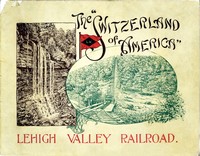
The source record for The "Switzerland of America": Lehigh Valley Railroad — Story, Setting & Ideas measures this digital text at 3,401 words, 15 min estimated reading time, and 1 detected text section.
The text analysis averages about 20.4 words per sentence, while the detected sections provide another way to judge how the source is divided.
Project Gutenberg metadata also associates the work with “Lehigh River Valley (Pa.) -- Pictorial works,” connecting these edition facts with the source record’s subject description.
Explore this collection
These alternatives are selected using recorded categories and estimated reading time.
About 21 minutes
Design Photography
4,676 recorded words. 6 minutes difference from this book's estimate.
View Gutenberg source #72546About 25 minutes
Design Photography
5,608 recorded words. 10 minutes difference from this book's estimate.
View Gutenberg source #69417About 33 minutes
Design Photography
7,531 recorded words. 18 minutes difference from this book's estimate.
View Gutenberg source #17275Search stored excerpts and compare books → Choose by your preferences →
Choices use stored catalog measurements. Estimates vary with reading speed. A shared category is a catalog label, not a claim that two books have the same argument or literary quality.
Search reads excerpt text stored with this catalog and links to its associated Gutenberg record. The connection is stored in the site database; this tool does not recheck that every excerpt is word-for-word identical to that external record. Excerpt search does not cover every chapter and does not verify historical publication dates.
Catalog snapshot checked: 2026-09-26. Coverage: 90 public books, 90 available source excerpts.
Calculated from edition completeness, EPUB availability, text structure and catalogue metadata. Not a user rating.
Total of 100 points, scaled to a 2.5-5.0 range. Editions with an empty description or a missing EPUB file are not scored.
Public-domain source text
The source text is kept in the dedicated reader, separate from this catalogue record and its commentary.
This 1897 publication contains no narrative prose. Its sole textual content is a list of 22 illustration titles and a copyright notice. The work is a photographic album: each page presents a full-page black-and-white photograph with a brief caption naming the location or feature. The absence of any descriptive or promotional text means the images themselves must carry all meaning. The sequence moves from the Musconetcong Curve in Pennsylvania to Niagara Falls, tracing the railroad's route through the Lehigh Valley and into New York. Without a written guide, the viewer's experience depends entirely on visual interpretation of these late-nineteenth-century landscapes.
The work's structure is defined solely by the order of its plates. The list of illustrations functions as a table of contents and a route map. It begins with a curve—Musconetcong Curve—suggesting an immediate focus on the railroad's engineering. Subsequent views alternate between natural features (Onoko Falls, Hemlock Lake) and human constructions (Lehigh University, Main Street, Rochester). The final two plates show Niagara Falls from the bridge and from the brink, ending the journey at a celebrated tourist destination. This progression implies a deliberate itinerary, but without captions beyond place names, the viewer must infer the narrative logic.
The captions reveal a consistent pairing of natural scenery with railroad infrastructure. Several plates highlight cuts and curves: Rockdale Cut, Switchback Curve, Cliff View, Summit of Alleghenies. These emphasize the railroad's passage through challenging terrain. Other views present scenic overlooks: Lehigh Valley from Piccadilly Hill, View East of Standing Stone, Towanda from Table Rock. The inclusion of Cornell University and Cayuga Lake, as well as Lake Front, Geneva, and Pierce's Pavilion at Clifton Springs, indicates stops at educational and resort destinations. The photographs likely document both the engineering achievement and the leisure opportunities along the line.
The sequence of images creates a rhythm of motion and pause. Early plates such as Musconetcong Curve and Switchback Curve emphasize the railroad's dynamic path through the landscape. Mid-album views like Onoko Falls and Cavern Cascade introduce vertical elements—waterfalls and gorges—that contrast with the horizontal sweep of the railroad. Later plates, including Hemlock Lake and Longwood Excursion Grounds, suggest restful destinations. The final pair of Niagara Falls images, one from the bridge and one from the brink, offer two perspectives on the same subject, inviting comparison. This pacing mimics the experience of a journey: moving, stopping, and observing from different vantage points.
Because the work contains no body text, readers should approach it as a visual document rather than a written account. The captions provide only location names; all interpretation of the scenes—their scale, atmosphere, and historical context—rests with the viewer. Comparing the listed illustrations with modern maps or photographs of the same sites may reveal changes in the landscape over more than a century. The album is best experienced as a silent travelogue, one that invites repeated looking and personal reflection on the relationship between railroads, tourism, and the American landscape at the end of the nineteenth century.
Flipping through that Lehigh Valley album, the silent locomotives and still rivers felt hushed in a way that lingered. It reminded me of the quiet, hands-on patience behind another kind of image-making, where light is coaxed rather than captured. That same tenderness for process lives in Bromoil printing and bromoil transfer — A Reader’s Guide, a manual I once held like a gentle secret, much like those railroad views.
Build a private reading journal entry for this title.