About 16 minutes
York: A Sketch-Book — Background and Themes
Architecture
3,529 recorded words. 1 minutes difference from this book's estimate.
View Gutenberg source #54328
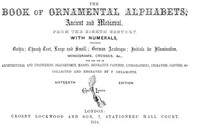
This digital edition of The Book of Ornamental Alphabets, Ancient and Medieval, from the Eighth Century With Numerals, including Gothic; Church Text, Large and Small; German Arabesque — Story, Setting & Ideas is described by source-level measurements including 3,804 words, 17 min estimated reading time, and 1 detected text section.
The text analysis averages about 19.0 words per sentence, while the detected sections provide another way to judge how the source is divided.
Project Gutenberg metadata also associates the work with “Alphabets,” connecting these edition facts with the source record’s subject description.
Explore this collection
These alternatives are selected using recorded categories and estimated reading time.
About 16 minutes
Architecture
3,529 recorded words. 1 minutes difference from this book's estimate.
View Gutenberg source #54328About 15 minutes
Architecture
3,356 recorded words. 2 minutes difference from this book's estimate.
View Gutenberg source #54198About 15 minutes
Architecture
3,306 recorded words. 2 minutes difference from this book's estimate.
View Gutenberg source #54220Search stored excerpts and compare books → Choose by your preferences →
Choices use stored catalog measurements. Estimates vary with reading speed. A shared category is a catalog label, not a claim that two books have the same argument or literary quality.
Search reads excerpt text stored with this catalog and links to its associated Gutenberg record. The connection is stored in the site database; this tool does not recheck that every excerpt is word-for-word identical to that external record. Excerpt search does not cover every chapter and does not verify historical publication dates.
Catalog snapshot checked: 2026-09-26. Coverage: 90 public books, 90 available source excerpts.
Calculated from edition completeness, EPUB availability, text structure and catalogue metadata. Not a user rating.
Total of 100 points, scaled to a 2.5-5.0 range. Editions with an empty description or a missing EPUB file are not scored.
Public-domain source text
The source text is kept in the dedicated reader, separate from this catalogue record and its commentary.
F. Delamotte's The Book of Ornamental Alphabets opens with a preface that frames the work as a practical response to a gap in the market: 'there are no works of Ancient Alphabets of any excellence published in a cheap form.' The author, a draughtsman and engraver, positions the collection as a tool for professionals—architectural draughtsmen, masons, decorative painters, lithographers, and engravers—rather than a scholarly history. The index immediately signals the book's chronological and geographical range, listing alphabets from the 8th century Vatican and British Museum manuscripts through to 16th-century examples from Albert Dürer's Prayer Book. This editorial note examines how the opening, middle, and later excerpts guide a first reading of this specialized reference work.
Delamotte's preface to the fourth edition is the most direct guide to the book's purpose and audience. He notes that the demand for a fourth edition 'within so short a period of the publication of the Third' convinced him the work was 'required by the public.' The preface also reveals his responsiveness to feedback: he introduces additions 'likely to enhance the interest and increase the value of the pages' as 'an indication of the esteem in which I have held the encouragement' of purchasers and critics. For a first-time reader, this preface establishes that the book is not a passive gallery but an evolving tool shaped by its users. The mention of 'additions' suggests that later editions expanded the collection, so readers should note that the plates may represent a curated selection rather than a comprehensive survey.
The index lists 35 entries, each keyed to a century and a source—such as '8th Century. Vatican,' '12th Century. From the Mazarin Bible,' or '16th Century. From Albert Durer's Prayer Book.' This structure immediately signals that the book is organized chronologically and by provenance, not by style or use. A first reader can use the index to locate alphabets from a specific period or manuscript, but the entries are terse: no descriptions of letterforms or historical context are provided in the index itself. The inclusion of 'Numerals' and 'Crosses' in the subtitle hints at additional content beyond alphabets, though the index does not list them separately. Readers should expect to flip between the index and the plates, cross-referencing the brief captions that likely accompany each illustration.
The excerpts do not include the plates themselves, but the index and preface indicate that the book is primarily a visual resource. Delamotte's profession as an engraver suggests the plates were his own work, and the phrase 'collected and engraved by F. Delamotte' implies he reproduced existing alphabets rather than designing new ones. The range of sources—from the British Museum, Bodleian Library, Vatican, and Westminster Abbey—points to a reliance on institutional collections. A first reader should approach each plate as a facsimile of a historical source, not a modern interpretation. The absence of explanatory text in the excerpts means readers must infer the context from the index entry alone. For example, '8th Century. British Museum' offers no clue about the manuscript's origin or purpose, leaving the reader to consult external references if needed.
The subtitle specifies the book is 'for the use of architectural and engineering draughtsmen, masons, decorative painters, lithographers, engravers, carvers, &c.' This list of trades suggests the alphabets were intended as models for practical application—carving inscriptions, painting decorative initials, or designing monograms. The preface's mention of 'a cheap form' underscores the book's accessibility: it was meant to put historical letterforms into the hands of working artisans who might not afford lavish facsimiles. A first reader from a non-specialist background should consider how each alphabet might be adapted for a specific medium: the 'German Arabesque' might suit ornamental carving, while 'Church Text, Large and Small' could guide ecclesiastical lettering. The book is a pattern book, not a history, and its value lies in the direct visual reference it provides.
As a first reader, treat The Book of Ornamental Alphabets as a practical reference rather than a narrative. The preface and index are your best guides: the former explains the book's intent and evolution, the latter maps its contents. When examining the plates, note the century and source listed in the index, and consider how the letterforms might have been used in their original context—whether in manuscripts, monuments, or printed books. The book's brevity (3,804 words) and reliance on images mean that the text is minimal; the real content is visual. For deeper understanding, consult the manuscripts cited, but for immediate use, Delamotte's collection offers a compact, affordable entry into centuries of ornamental lettering.
That rainy afternoon, tracing the angular strokes of Church Text in Delamotte’s alphabets, I felt the weight of centuries in each carved letter. My pencil drifted to the margins, sketching imagined ruins. The thought of permanence, of time’s engraving, led me—almost by accident—to a volume of Piranesi’s etchings. His vast, shadowed arches echoed something in those letterforms, and Selected etchings by Piranesi, series 2 — Text and Context sat beside me until dusk.
Capture what you thought, learned, and would like to remember.