About 15 minutes
Canterbury: A Sketch Book — Reading Notes
Architecture
3,356 recorded words. 0 minutes difference from this book's estimate.
View Gutenberg source #54198
Before opening Oxford: A Sketch-Book — Story, Setting & Ideas, the edition data offers a quick orientation: 3,306 words, 15 min estimated reading time, and 1 detected text section.
The text analysis averages about 20.4 words per sentence, while the detected sections provide another way to judge how the source is divided.
Project Gutenberg metadata also associates the work with “University of Oxford -- Pictorial works,” connecting these edition facts with the source record’s subject description.
Explore this collection
These alternatives are selected using recorded categories and estimated reading time.
About 15 minutes
Architecture
3,356 recorded words. 0 minutes difference from this book's estimate.
View Gutenberg source #54198About 15 minutes
Architecture
3,263 recorded words. 0 minutes difference from this book's estimate.
View Gutenberg source #54313About 15 minutes
Architecture
3,295 recorded words. 0 minutes difference from this book's estimate.
View Gutenberg source #54315Search stored excerpts and compare books → Choose by your preferences →
Choices use stored catalog measurements. Estimates vary with reading speed. A shared category is a catalog label, not a claim that two books have the same argument or literary quality.
Search reads excerpt text stored with this catalog and links to its associated Gutenberg record. The connection is stored in the site database; this tool does not recheck that every excerpt is word-for-word identical to that external record. Excerpt search does not cover every chapter and does not verify historical publication dates.
Catalog snapshot checked: 2026-09-26. Coverage: 90 public books, 90 available source excerpts.
Calculated from edition completeness, EPUB availability, text structure and catalogue metadata. Not a user rating.
Total of 100 points, scaled to a 2.5-5.0 range. Editions with an empty description or a missing EPUB file are not scored.
Public-domain source text
The source text is kept in the dedicated reader, separate from this catalogue record and its commentary.
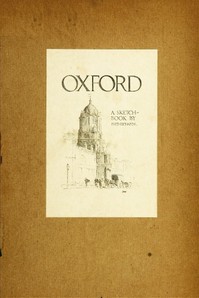
Fred Richards' Oxford: A Sketch-Book (1915) presents twenty-four drawings that move from the monumental—Christchurch's Tom Tower—to the pastoral view from the Hinksey Path. The list of plates itself functions as a walking itinerary, grouping college interiors (Balliol corner, Trinity porter's lodge) with public landmarks (Carfax, the Radcliffe Camera). Richards' eye favors enclosed spaces: quadrangles, cloisters, and gateways, often framing a distant tower or sundial. The drawings rely on line and shadow rather than color, suggesting an architectural draughtsman's discipline.
The plate order mimics a pedestrian route through central Oxford. It begins at Christchurch, cuts to Carfax, then threads through Balliol, St John's, Trinity, and Broad Street before reaching the Sheldonian. The Camera appears three times—from Brasenose, All Souls, and as a standalone—underscoring its centrality. Later plates move south: St Aldate's, Folly Bridge, and the Hinksey Path. This progression implies a single afternoon's walk, with the river as a natural terminus.
Richards repeatedly uses architectural frames: a gateway, a cloister arch, or a tower's edge. 'Outside St John's Gateway' and 'The Porter's Lodge, Trinity' treat thresholds as subjects. 'Magdalen College, Cloisters' and 'Quadrangle in Merton' emphasize enclosed stone courts. Even 'The High, from Top of Magdalen Tower' offers a rooftop vantage. These choices direct the viewer's eye along sightlines, making the built environment feel both intimate and monumental.
Notable absences include the Bodleian's interior (only Duke Humphrey's Library is named), the Bridge of Sighs, and any modern buildings. Richards avoids crowded scenes; no plate shows more than a few figures. The river views—'The River from Folly Bridge' and 'Oxford from the Hinksey Path'—are nearly empty of boats or people. This selectivity suggests a preference for architecture over human activity, aligning with the sketch-book's subtitle as a record of stone and space.
The plate list, repeated twice in the text, serves as both table of contents and poetic inventory. Its rhythm—'Tom Tower, Christchurch. Carfax. A Corner of Balliol. Outside St John's Gateway'—creates a litany of place-names. The repetition of 'The Camera' and 'St Aldate's' reinforces key sites. This cataloguing mirrors the sketch-book's function: not a narrative but a collection of views, each titled with a location and a framing preposition ('from', 'outside', 'in').
Readers approaching Richards' sketch-book should attend to what is not drawn as much as what is. The absence of interiors, crowds, and modern intrusions reveals a deliberate vision of Oxford as a sequence of stone enclosures. The drawings reward slow looking: note how each plate uses a gateway or tower to anchor the composition. This is a book to be walked through, page by page, as if tracing a route from Tom Tower to the Hinksey Path.
The rain kept the clatter of Oxford off the quad; I just traced Richards’s stonework, watching how he frames a doorway. It made me think of churches as built stories, not just scenery. Later, idly, I picked up Bell's Cathedrals: Wimborne Minster and Christchurch Priory A Short History of Their Foundation and a Description of Their Buildings — Text and Context. The same quiet pleasure in learning how a wall remembers its purpose.
Use these questions to collect your thoughts before moving on.