About 15 minutes
Oxford: A Sketch-Book — Story, Setting & Ideas
Architecture
3,306 recorded words. 0 minutes difference from this book's estimate.
View Gutenberg source #54220
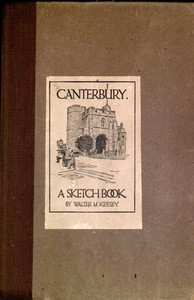
The catalog record for Canterbury: A Sketch Book — Reading Notes provides practical reading context through 3,356 words, 15 min estimated reading time, and 1 detected text section.
The text analysis averages about 20.2 words per sentence, while the detected sections provide another way to judge how the source is divided.
Project Gutenberg metadata also associates the work with “Canterbury (England) -- Pictorial works,” connecting these edition facts with the source record’s subject description.
Explore this collection
These alternatives are selected using recorded categories and estimated reading time.
About 15 minutes
Architecture
3,306 recorded words. 0 minutes difference from this book's estimate.
View Gutenberg source #54220About 15 minutes
Architecture
3,263 recorded words. 0 minutes difference from this book's estimate.
View Gutenberg source #54313About 15 minutes
Architecture
3,295 recorded words. 0 minutes difference from this book's estimate.
View Gutenberg source #54315Search stored excerpts and compare books → Choose by your preferences →
Choices use stored catalog measurements. Estimates vary with reading speed. A shared category is a catalog label, not a claim that two books have the same argument or literary quality.
Search reads excerpt text stored with this catalog and links to its associated Gutenberg record. The connection is stored in the site database; this tool does not recheck that every excerpt is word-for-word identical to that external record. Excerpt search does not cover every chapter and does not verify historical publication dates.
Catalog snapshot checked: 2026-09-26. Coverage: 90 public books, 90 available source excerpts.
Calculated from edition completeness, EPUB availability, text structure and catalogue metadata. Not a user rating.
Total of 100 points, scaled to a 2.5-5.0 range. Editions with an empty description or a missing EPUB file are not scored.
Public-domain source text
The source text is kept in the dedicated reader, separate from this catalogue record and its commentary.
Walter M. Keesey's Canterbury: A Sketch Book (1915) is a sequence of twenty-four pencil drawings, each titled and dated 1914, that record the city's architecture without any accompanying prose. The opening plate, "The Westgate," immediately establishes the artist's interest in medieval gateways and the play of light on stone. The list of plates functions as the book's only text, guiding the reader from the Westgate through the cathedral precincts, cloisters, and streets to outlying views like "The Mill overlooking the City" and "The Dane John." This structure invites a sequential visual tour, with each drawing offering a distinct vantage point on Canterbury's built environment.
The twenty-four plates follow a deliberate route through Canterbury, beginning at the Westgate and moving toward the cathedral. The early plates—"The Approach," "South Choir Aisle And Pilgrim's Steps," "The Cathedral Close"—concentrate on the cathedral's exterior and interior spaces. Later plates shift to secular landmarks: "Mint Yard. King's School," "Queen Elizabeth's Chambers," "St Georges' Street. Newingate." The final plates, such as "The Norman Staircase," return to medieval details. This progression suggests a walk that moves from the city's edge to its heart and back out to the periphery, offering multiple perspectives on the same structures.
Several plates revisit similar subjects from different angles. The cathedral appears in at least eight drawings: the South Choir Aisle, the North Transept and Baptistry, the Chapel of Our Lady of the Undercroft, the East end from Lady Wooten's Green, the Crypt from the Fields, and the Cathedral from the Fields. The Westgate appears twice, once as the opening plate and again as "The Westgate. Evening." This repetition emphasizes the artist's interest in how light and time of day alter the appearance of stone. The drawings of "Mercery Lane" and "Old Houses. corner of The Friars" show domestic architecture, contrasting with the monumental cathedral.
Seven plates bear the signature "W.M. KEESEY. 1914." These include "The Cathedral Close from the East," "The Chapel of Our Lady of the Undercroft," "The Crypt from the Fields," "Mint Yard. King's School," "The Westgate. Evening," "Mercery Lane," and "Old Houses. corner of The Friars." The dated plates are distributed throughout the book, suggesting that Keesey completed the drawings during a single year. The signature placement varies—some appear at the bottom of the image, others at the side—but consistently marks the artist's hand. The absence of a signature on other plates may indicate a different stage of completion or a choice to let the architecture speak without authorial mark.
Beyond the title page and list of plates, the book contains no descriptions, historical notes, or captions. The reader encounters only the drawings themselves. This silence forces attention to visual details: the texture of stone, the angle of roofs, the empty streets. Without text, the sequence becomes a purely pictorial record. The viewer must infer the significance of each site from its appearance alone. The book thus functions as a sketchbook in the literal sense—a collection of observations rather than a guide. The lack of commentary also means that the drawings must stand on their own as evidence of the artist's eye and the city's character.
Because the book offers no written context, readers may wish to consult a map of Canterbury to trace Keesey's route. The drawings reward close looking: note the direction of light, the presence or absence of figures, and the degree of detail in each plate. The sequence from gate to cathedral to river and back to gate suggests a circular walk, one that could be retraced today. Keesey's Canterbury is a city of stone and shadow, recorded with a pencil that respects both the grand cathedral and the humble corner.
There’s something tender about Keesey’s silent pencil lines, each drawing a small holding of time. I felt that same quiet reverence flipping through Knole and the Sackvilles — Edition Insights, where history lingers in corners rather than announcing itself. Both books feel like old friends who don’t need to talk much, just sit with you awhile.
Capture what you thought, learned, and would like to remember.