About 27 minutes
Birket Foster, R.W.S. Sixteen examples in colour of the artist's work — Edition Insights
Architecture
6,012 recorded words. 0 minutes difference from this book's estimate.
View Gutenberg source #37714
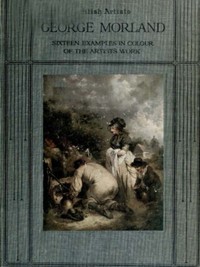
The source record for George Morland: Sixteen examples in colour of the artist's work — Background and Themes measures this digital text at 6,068 words, 27 min estimated reading time, and 1 detected text section.
The text analysis averages about 24.7 words per sentence, while the detected sections provide another way to judge how the source is divided.
Project Gutenberg metadata also associates the work with “Morland, George, 1763-1804,” connecting these edition facts with the source record’s subject description.
Explore this collection
These alternatives are selected using recorded categories and estimated reading time.
About 27 minutes
Architecture
6,012 recorded words. 0 minutes difference from this book's estimate.
View Gutenberg source #37714About 28 minutes
Architecture
6,250 recorded words. 1 minutes difference from this book's estimate.
View Gutenberg source #22847About 26 minutes
Architecture
5,813 recorded words. 1 minutes difference from this book's estimate.
View Gutenberg source #44539Search stored excerpts and compare books → Choose by your preferences →
Choices use stored catalog measurements. Estimates vary with reading speed. A shared category is a catalog label, not a claim that two books have the same argument or literary quality.
Search reads excerpt text stored with this catalog and links to its associated Gutenberg record. The connection is stored in the site database; this tool does not recheck that every excerpt is word-for-word identical to that external record. Excerpt search does not cover every chapter and does not verify historical publication dates.
Catalog snapshot checked: 2026-09-26. Coverage: 90 public books, 90 available source excerpts.
Calculated from edition completeness, EPUB availability, text structure and catalogue metadata. Not a user rating.
Total of 100 points, scaled to a 2.5-5.0 range. Editions with an empty description or a missing EPUB file are not scored.
Public-domain source text
The source text is kept in the dedicated reader, separate from this catalogue record and its commentary.
E. D. Cuming's introduction to sixteen colour plates of George Morland's work opens by noting that the painter was 'reared in the studio' as the son of a picture restorer. Morland's early talent is evidenced by chalk drawings exhibited at the Royal Academy when he was ten. Yet Cuming emphasizes that Morland's formal education was minimal, his father keeping him 'too closely at work with pencil and brush' for book learning. The tension between innate skill and deliberate isolation from artistic tradition becomes a central thread.
Cuming describes how Morland, after his apprenticeship, rejected offers from both Sir Joshua Reynolds and Romney. Reynolds urged that the boy be brought up in 'the grand line' of art, but his father declined; Romney offered a salaried pupillage, which Morland himself refused. This pattern of independence extended to his working method: Morland 'never made studies, but developed the picture under his hand as he worked upon it.' Cuming attributes the 'straightforward simplicity' of Morland's art partly to this improvisational approach. The painter also avoided studying other artists' works, fearing he would become an imitator, and instead went 'direct to Nature for all he required.'
Cuming notes that Morland's colour schemes were 'subdued rather than brilliant,' yet he held a firm principle: 'a touch of pure red should appear in every picture.' This recurring detail is traceable across the plates. The composition, Cuming observes, is 'rarely otherwise than pleasing,' a notable achievement given Morland's lack of preparatory sketches. The author also points out that Morland was 'not conspicuously successful' when painting sheep, a specific limitation that contrasts with his general skill. The plates themselves—titles such as Idleness, Diligence, The Deserter's Farewell, and Justice; or, The Merciless Bailiff—suggest a moral or narrative dimension that Cuming touches on only lightly.
Cuming introduces a speculative comparison between Morland and the French painter Jean Baptiste Siméon Chardin (1699–1779), noting that the resemblance in their figure subjects is 'certainly striking.' He links this to Morland's maternal French nationality, suggesting 'hereditary talent from the maternal side.' However, Cuming acknowledges that no marriage record for Morland's parents has been found in parish registers. He also notes, perhaps pointedly, that Chardin's two daughters died in infancy—a detail that does not directly connect to Morland but hints at the biographer's wider research. This section exemplifies Cuming's willingness to offer informed conjecture while marking its limits.
Cuming's text, originally published in 1910, serves as a concise companion to the plates rather than a full biography. Readers may find it useful to examine the images alongside his remarks on colour, method, and subject matter. The introduction's brevity—under 6,000 words—leaves room for personal observation of the sixteen works, which range from rural scenes to moral allegories. Cuming's voice is that of a knowledgeable guide who respects the painter's singularity without overinterpreting it.
I found myself lingering over Cuming’s quiet praise of Morland’s refusal to copy others, trusting instead whatever the lane and hedgerow offered directly. That same unhurried patience seemed to follow me into If You're Going to Live in the Country — Reading Notes, where the knowing is just as modest, just as rooted in looking carefully rather than posing smartly. Two different worlds, one familiar tenderness.
A brief reflection can help important ideas stay with you longer.