The artillerist's manual and British soldier's compendium — Themes and Context

(0 User reviews)   342
In Category - Architecture
Griffiths, F. A. (Frederick Augustus), -1869 Project Gutenberg 2024 Not confirmed
Artillery drill and tactics; Great Britain. Army -- Handbooks, manuals, etc.; Great Britain. Army -- Artillery -- Drill and tactics Readers of public-domain and historical texts
Project Gutenberg digital edition en

Edition facts

Words 117,906
Reading time 513 min
Text sections 103

The catalog record for The artillerist's manual and British soldier's compendium — Themes and Context provides practical reading context through 117,906 words, 8 hr 33 min estimated reading time, and 103 detected text sections.

The text analysis averages about 14.5 words per sentence, while the detected sections provide another way to judge how the source is divided.

Project Gutenberg metadata also associates the work with “Artillery drill and tactics,” connecting these edition facts with the source record’s subject description.

A 19th-century British artillery manual detailing drill, equipment, and field procedures for guns, howitzers, mortars, and rockets, with numbered detachments and step-by-step commands.
Share
Editorial Edition Score 4.9/5

Calculated from edition completeness, EPUB availability, text structure and catalogue metadata. Not a user rating.

How this score is calculated
  • Description quality20 pts
  • Title & short description10 pts
  • Source metadata20 pts
  • Text length15 pts
  • Chapters / structure15 pts
  • EPUB file integrity20 pts

Total of 100 points, scaled to a 2.5-5.0 range. Editions with an empty description or a missing EPUB file are not scored.

Edition quality

Read the Text

| | | | | { 8 Inch | 7·86 | 0·82 | 10 | | { 32 Pr. | 6·177 | 0·64 | 6 | | { 24 ” | 5·595 | 0·58 | 3 | | SHRAPNELL { 18 ” | 5·099 | 0·53 | | | DIAPHRAGM { 12 ” | 4·454 | 0·477 | 1 12 | | { 9 ” | 4·08 | 0·41 | 1 8 | | { 6 ” | 3·55 | 0·356 | 0 0 12 | +-----------------------+-----------+------------+-------------+

All shells are now issued in the Field Service, _loaded_, and secured with a metal plug.

SHOT, CASE OR CANISTER.

The common Case or Canister shot consists of a number of balls packed in tin canisters of a cylindrical form: the balls being of different weights according to the size of the gun. For field service the balls are counted into the case, and laid in tiers, but for other purposes they are loosely thrown in till the case is filled. The top being soldered on, the bottom of the tin case is nailed on to the wooden bottom, and the heads of the nails are soldered. These shot should seldom be used at a greater distance than 300 yards, and even at that range they scatter so much as to be nearly unserviceable; but at from 100 to 200 yards they are very destructive.

+----------------------------------------------------------------+ | SHOT, COMMON CASE, OR CANISTER. | +-------------------------+------------+-----------+-------------+ | Nature of Ordnance. | Weight | Number in | Weight of | | | of ball. | each case.| case filled.| +-------------------------+------------+-----------+-------------+ | | lb. oz. | | lb. oz. dr. | | IRON GUNS. 10 Inch* | 1 | 34} | 82 7 | | | 13⅛ | 50} | | | 8 Inch* | 8 | 90 | 48 12 | | 8 Inch* | 8 | 90 | 48 12 | | 68 Pr.* | 8 | 90 | 50 4 | | 56 Pr.* | 1 | 50 | 52 11 | | 42 Pr.† | 8 | 85 | 45 15 | | 32 Pr.† | 8 | 66 | 34 13 | | 24 Pr.† | 8 | 46 | 10 7 | | 18 Pr.† | 6 | 46 | 10 7 | | 12 Pr.† | 4 | 46 | 12 2 | | 9 Pr.† | 3 | 44 | 9 11 | | 6 Pr.† | 2 | 40 | 5 10 | | 3 Pr.† | 1½ | 34 | 3 9 8 | | | | | | | BRASS GUNS. 12 Pr.‡ | 2 | 126 | 17 4 | | ‡ | 6½ | 41 | 16 14 | | 9 Pr.‡ | 1½ | 126 | 12 15 | | ‡ | 5 | 41 | 13 2 8 | | 6 Pr.‡ | 1½ | 85 | 8 13 | | ‡ | 3¼ | 41 | 8 15 8 | | 3 Pr.‡ | 1½ | 41 | 4 3 8 | | | | | | | HOWITZERS. 10 Inch* | 8 | 170 | 85 6 | | 8 Inch* | 2 | 258 | 35 15 8 | | 5½ Inch† | 2 | 100 | 14 11 8 | | 4⅖ Inch† | 2 | 55 | 7 14 8 | | 24 Pr.* | 2 | 140 | 19 0 8 | | 12 Pr.* | 2 | 84 | 11 9 | | | | | | | CARRONADES. 68 Pr.† | 8 | 90 | 47 5 8 | | 42 Pr.† | 8 | 66 | 33 11 | | 32 Pr.† | 8 | 40 | 20 13 | | 24 Pr.† | 8 | 32 | 16 12 8 | | 18 Pr.† | 6 | 31 | 12 14 | | 12 Pr.† | 4 | 32 | 8 3 8 | | 9 Pr.† | 3 | 30 | 6 7 8 | | 6 Pr.† | 2 | 30 | 4 9 | +-------------------------+------------+-----------+-------------+ * Iron Tampeon. † Wood Tampeon. ‡ Tier Shot.

+----------------------------------------------------------------+ | SHOT, GRAPE. | +-------------------------+------------+-----------+-------------+ | Nature of Ordnance. | Weight | Number in | Weight of | | | of ball. | each case.| Grapeshot. | +-------------------------+------------+-----------+-------------+ | | lb. oz. | | lb. oz. dr. | | GUNS. 10 Inch | 3 | 24 | 81 | | Shot Quilted. 68 Pr. } | 3 | 15 | 50 7 | | 8 Inch} | | | | | 56 Pr. | 4 | 12 | 56 14 | | 42 Pr. | 4 | 9 | 41 6 | | 32 Pr. | 3 | 9 | 29 11 | | 24 Pr. | 2 | 9 | 20 10 | | 18 Pr. | 1 8 | 9 | 16 12 | | 12 Pr. | 1 | 9 | 11 2 | | 9 Pr. | 13⅛ | 9 | 8 12 | | 6 Pr. | 8 | 9 | 8 7 | | 3 Pr. | 8 | 9 | 2 9 | | | | | | | CARRONADES. 68 Pr. | 3 | 15 | 52 8 | | Tin Case Shot.† 42 Pr. | 4 | 9 | 37 15 | | 32 Pr. | 3 | 9 | 30 6 | | 24 Pr. | 2 | 9 | 20 9 | | 18 Pr. | 1 8 | 9 | 15 10 | | 12 Pr. | 1 | 9 | 11 0 8 | | 9 Pr. | 13⅛ | 9 | 9 1 | | 6 Pr. | 8 | 9 | 5 2 | +-------------------------+------------+-----------+-------------+ † Wood Tampeon.

NATURE. BEDS. BLOCKS. Length. Breadth. Thickness. Length. Breadth. Depth. ft. in. in. ft. in. in. in. 42 Pr. 2·91 11 4·5 1 5 4·75 9 32 ” 2·91 10 4·25 1 5 4·75 9 24 ” 2·83 10 4·25 1 4 4·5 8 18 ” 2·85 9·5 4·25 1 3 4·5 8 12 ” 2·85 9·5 4 1 3 4·5 8 9 ” 2·85 9·5 4 1 1 4·5 8

Tubes are of five different natures—viz., Common quill, and Dutch or Paper tubes for exercise, and Detonating quill, and Brass tubes; and Friction tubes for service.

All tubes are gauged to two-tenths of an inch diameter.

The pipes for the _Quill tubes_ are 2½ inches long; and the barrels of _Dutch tubes_ are 1¾ inch in length.[12]

_Composition for Common tubes._

Mealed powder, mixed with spirits of wine into a stiff paste.

The quills of these tubes are cut to 2¾ inches in length. Small, or pigeon quills, are also prepared for the arms to receive the detonating composition; these are cut to ¾ of an inch in length; and a small hole is bored in the centre to communicate the composition to the body of the tube. The body of the tube is filled precisely in the same way as common tubes.

_Composition for the Crosses, or Arms, of Detonating tubes._

grains. Chlorate of potassa 230 Antimony 230 Glass, finely pounded 73

_Brass tubes_, _common_, are 3 inches long, and the cups, previous to being stamped, are one inch in diameter.

They are filled similarly to common quill tubes.

These tubes are of copper, and are three inches in length. The detonating composition is inserted in a tin arm, into which is introduced and pressed down tight, by the sides of the aim, a piece of copper, grooved; with a small ring to receive the cord for firing the tube, and gun.

Length, 14 ft. 6 in. Breadth, 11 ft. 6 in. Weight, 50 lb.

They are riveted to shot for brass guns to prevent the bore being indented in front of the seat of the shot by the first impulse of the powder: and to Shells, to keep the fuze in the centre of the bore.

FIELD BATTERY EXERCISE.[13]

_Section. 1. Telling off the Detachments._[14]

_Section 2. Posts of the Detachment._

No. 1. At the handspike.

Nos. 2, 3. Outside the wheels: with Howitzers rather in rear of the muzzle; with Guns in line with the front of the wheels.

Nos. 4, 5. In line with the breech.

No. 6. Five yards in rear of the left wheel.

No. 7. In rear of the Limber.

No. 8. Ten yards in rear of No. 6.

No. 9. Four yards in rear of the Limber.

_Art. 2.—In Order of March._

No. 1. On the off-side at the wheel horses’ heads.

Nos. 2, 3. In line with the muzzle.

Nos. 4, 5. In line with the breech.

Nos. 6, 7. In line with the axletree of the Limber.

Nos. 8, 9. In line with the splinter bar.

In line, ten yards in front of the leading horses.

In line, two yards in rear of the muzzle of the Gun.

_Art. 5._—In line with the gun axletree, one yard to the right or left of the wheel.

No. 1. On the right.} On the Gun limber. No. 6. On the left. } No. 3. On the right.} On the Waggon limber. No. 2. On the left. }

No. 3. On the right.} On the front of the Waggon body. No. 2. On the left. }

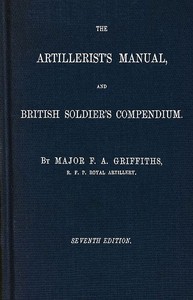
Major F. A. Griffiths’s seventh edition (1856) of The Artillerist’s Manual opens with a preface listing alterations and additions—percussion small arms, rocket exercise, and instructions for landing seamen with field pieces—signaling a work in active revision. The text immediately immerses the reader in numbered detachments: each gun crew is assigned specific roles (No. 1 attends the pawl, No. 3 handles the left lever), and every movement is broken into crisp commands like “Heave in the slack” and “Left lever fetch.” This structure, built around repeated sequences for slinging, unslinging, and marching, gives the manual a rhythmic, almost choreographic quality.

Numbered Detachments and Command Sequences

The manual’s core unit is the detachment—typically one non-commissioned officer and eight men for a sling waggon, or six for lighter ordnance. Each man is assigned a fixed station (left side, right side) and a set of duties: No. 2 and No. 3 handle levers and skidding; No. 5 and No. 4 manage handspikes and raise the weight for lashing. Commands follow a predictable pattern: “Prepare to raise the right trunnion. Heave in the slack. Take up levers. Right lever take purchase. Heave.” The repetition of “Hold on” and “Fetch” creates a call-and-response that governs the pace of lifting. This systematic numbering extends to the sling cart and sling waggon, where the same roles reappear with slight modifications—No. 1 always commands and attends the pawls.

Slinging and Unslinging as Reversible Procedures

A striking feature is the manual’s treatment of slinging and unslinging as mirror-image processes. For a gun, the sequence begins with backing the cart over the piece, scotching the wheels, and overhauling the sling; unslinging reverses each step: “Unlash levers, and handspikes. Unlash the prypole. Man the levers. Ease off.” The same logic applies to howitzers and mortars: a mortar is slung with the muzzle to the rear, and unslinging is described simply as “just the reverse of slinging, each number undoing what he had previously done.” This symmetry reduces cognitive load for soldiers learning multiple pieces of ordnance, and the text reinforces it by cross-referencing earlier sections (e.g., “See ‘Unslinging a Gun’”).

Recurring Equipment and Materials

Throughout the excerpts, specific items recur with precise specifications: a sling of five-inch white rope, 2½ fathoms long, with an eye-splice at each end; a breech rope of 2½-inch tarred rope, six fathoms long; two levers six feet nine inches long; two pieces of skidding about four feet long and six or seven inches square. These details anchor the abstract commands in tangible objects. The sling waggon itself weighs about 29 cwt., and the text notes that a detachment of six men can handle any weight below a 24-pounder. The consistency of these measurements—rope diameters, lengths, and weights—suggests a standardized arsenal, and the manual’s reliance on such constants allows the drill to be executed without variation across different units.

Movement Between Scenes: From Field to Shipboard

The preface’s list of additions includes “Instructions for the exercise, and service of great guns, and shells, on board Her Majesty’s ships” and “Instructions for landing seamen, and marines, with Field pieces,” indicating that the manual bridges land and naval contexts. The sling cart and sling waggon sections focus on moving heavy ordnance across terrain—skidding under the gun, backing the cart, scotching wheels—while the shipboard instructions (not excerpted) would adapt these procedures to decks and gangways. This movement between environments is mirrored in the text’s own structure: it shifts from field artillery to mortars to rockets, each with its own detachment and equipment list, yet the underlying command language remains constant. The manual thus functions as a portable toolkit for the soldier, equally applicable to a muddy field or a rolling deck.

Readers approaching this manual should attend to its layered structure: the preface signals what has changed since the sixth edition, but the body of the work preserves older material alongside new. The numbered detachments and reversible procedures reward careful study—each command has a counterpart, each piece of equipment a specified length. The text is best read not as a narrative but as a script for repeated physical action, where the rhythm of “Heave” and “Halt” governs the movement of iron and timber.

There’s something strangely calming about a manual that tells you exactly where to stand, what to hold, and when to move — all that precision becomes a kind of quiet rhythm. I found myself thinking of that same patient order while reading The Principles of Ornament — A Closer Reading, how even decoration has its own hidden discipline. It stayed with me like a slow, familiar tune.

There are no reviews for this eBook.

0
0 out of 5 (0 User reviews )

Add a Review

Your Rating *
There are no comments for this eBook.

Reader reflection

Take a moment to reflect on this book

Create a short personal record of your experience with this book.

Your progress 0 / 10
1

Which reading stage best describes you?

2

Did this book hold your interest?

3

Would you encourage someone else to read it?

4

How much effort did this book require?

Related eBooks