About 15 minutes
Canterbury: A Sketch Book — Reading Notes
Architecture
3,356 recorded words. 0 minutes difference from this book's estimate.
View Gutenberg source #54198
This digital edition of Harrow: A Sketch Book — Text and Context is described by source-level measurements including 3,298 words, 15 min estimated reading time, and 1 detected text section.
The text analysis averages about 20.1 words per sentence, while the detected sections provide another way to judge how the source is divided.
Project Gutenberg metadata also associates the work with “Harrow (London, England) -- Pictorial works,” connecting these edition facts with the source record’s subject description.
Explore this collection
These alternatives are selected using recorded categories and estimated reading time.
About 15 minutes
Architecture
3,356 recorded words. 0 minutes difference from this book's estimate.
View Gutenberg source #54198About 15 minutes
Architecture
3,306 recorded words. 0 minutes difference from this book's estimate.
View Gutenberg source #54220About 15 minutes
Architecture
3,263 recorded words. 0 minutes difference from this book's estimate.
View Gutenberg source #54313Search stored excerpts and compare books → Choose by your preferences →
Choices use stored catalog measurements. Estimates vary with reading speed. A shared category is a catalog label, not a claim that two books have the same argument or literary quality.
Search reads excerpt text stored with this catalog and links to its associated Gutenberg record. The connection is stored in the site database; this tool does not recheck that every excerpt is word-for-word identical to that external record. Excerpt search does not cover every chapter and does not verify historical publication dates.
Catalog snapshot checked: 2026-09-26. Coverage: 90 public books, 90 available source excerpts.
Calculated from edition completeness, EPUB availability, text structure and catalogue metadata. Not a user rating.
Total of 100 points, scaled to a 2.5-5.0 range. Editions with an empty description or a missing EPUB file are not scored.
Public-domain source text
The source text is kept in the dedicated reader, separate from this catalogue record and its commentary.
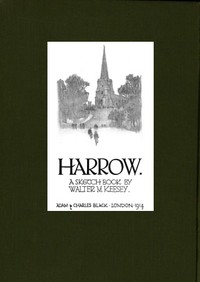
Walter M. Keesey's Harrow: A Sketch Book, published in 1914, presents twenty-four drawings of Harrow School and the surrounding village. The list of plates—ranging from the High Street and the Old Schools to the Fourth-form Room and the Vaughan Library interior—reveals a deliberate sequence that moves from public streets into the school's inner spaces. The first image, Harrow Church, serves as the title page, immediately grounding the viewer in the town's ecclesiastical and educational identity.
The sketch book's structure suggests a walking tour: after the church, the eye follows the High Street, then enters the Old Schools, and proceeds to specific rooms like the Fourth-form Room. Later plates, such as “Evening on the Terrace” and “Evening from the Fields,” shift to atmospheric views, indicating a temporal arc from day to dusk. This arrangement invites the reader to experience Harrow not as a static collection of buildings but as a lived environment shaped by light and season.
The plate list functions as a table of contents and a route. Keesey begins with the parish church, then moves to the High Street—the commercial spine—before entering the school precincts. The Old Schools appear twice: once as a standalone view and later from the “Milling Ground,” a student gathering area. This repetition suggests that Keesey wanted to show the same structure from different vantage points, emphasizing how perspective alters the experience of architecture.
Interior views are rare but significant: the Fourth-form Room is drawn twice, and the Vaughan Library interior appears once. The Head Boy's Den in the Head's House offers a glimpse into a private, hierarchical space. By including both public and restricted areas, the sketch book implies that Harrow's identity is shaped by its hidden corners as much as its facades.
The terrace appears in three plates: “The Terrace,” “From The Terrace,” and “The Terrace from the Museum.” This repeated focus on a single architectural feature—a raised walkway—suggests its importance as a social and observational hub. The terrace likely offered views over the school grounds and beyond, a liminal space between the built environment and the countryside.
Two evening scenes, “Evening on the Terrace” and “Evening from the Fields,” bookend the collection with a shift in light and mood. The former keeps the viewer on the terrace; the latter pulls back to the fields, framing the school as a distant silhouette. These plates imply that Keesey was attentive to the time of day and its effect on atmosphere, a detail that enriches the otherwise documentary approach.
Several plates name specific school features: the School Chapel, Pope's House (a boarding house), the Vaughan Library, and the Headmaster's Garden Front. The inclusion of the Head Boy's Den—a small, personal space—contrasts with the grander institutional buildings. This mix of scales suggests that Keesey aimed to capture both the formal and the intimate aspects of school life.
The “Byron” Tomb (the poet Lord Byron attended Harrow) and the Parish Church connect the school to broader literary and religious histories. Shops on the High Street and the view of “The Hill from the South” ground the school in its commercial and topographical context. Together, these landmarks create a layered portrait of Harrow as a place where tradition, daily routine, and natural setting intersect.
Keesey's sketch book does not include written descriptions; the plates are the sole content. This absence of text places the viewer in an active role, interpreting each drawing without explanatory captions. The sequence itself becomes a narrative: entering from the church, moving through streets and school gates, pausing in rooms, and finally stepping back to the fields at evening.
The two views of the Fourth-form Room—a classroom—hint at the repetitive, ritualized nature of school life. By drawing it twice, Keesey may be emphasizing its centrality to the student experience. The viewer is left to imagine the sounds and activities that would have filled these spaces, making the sketch book a prompt for reflection rather than a comprehensive record.
As a first-time reader, approach Harrow: A Sketch Book as a visual itinerary. Notice how Keesey guides your eye from public to private, from day to evening, and from wide views to intimate interiors. The absence of text means that each drawing must speak for itself; consider what details—a window, a roofline, a shadow—recur across plates. This sketch book is best experienced slowly, allowing each image to build a cumulative sense of place.
Keesey’s Harrow keeps its quiet places—a bench, a worn stone step—where boys once sat and thought. I find the same hush in Turquois mosaic art in ancient Mexico — Reading Notes, as if both books understood that craftsmanship and memory need no loud voice, only patient hands and a still room.
Use these questions to collect your thoughts before moving on.