About 214 minutes
Thoughts on Art and Life — Context and Discussion
Architecture
49,027 recorded words. 0 minutes difference from this book's estimate.
View Gutenberg source #29904
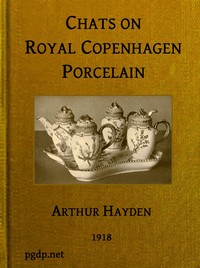
The catalog record for Chats on Royal Copenhagen Porcelain — Text and Context provides practical reading context through 49,128 words, 3 hr 34 min estimated reading time, and 8 detected text sections.
The text analysis averages about 19.9 words per sentence, while the detected sections provide another way to judge how the source is divided.
Project Gutenberg metadata also associates the work with “Pottery -- Marks,” connecting these edition facts with the source record’s subject description.
Explore this collection
These alternatives are selected using recorded categories and estimated reading time.
About 214 minutes
Architecture
49,027 recorded words. 0 minutes difference from this book's estimate.
View Gutenberg source #29904About 218 minutes
Architecture
49,940 recorded words. 4 minutes difference from this book's estimate.
View Gutenberg source #53624About 200 minutes
Architecture
45,777 recorded words. 14 minutes difference from this book's estimate.
View Gutenberg source #58887Search stored excerpts and compare books → Choose by your preferences →
Choices use stored catalog measurements. Estimates vary with reading speed. A shared category is a catalog label, not a claim that two books have the same argument or literary quality.
Search reads excerpt text stored with this catalog and links to its associated Gutenberg record. The connection is stored in the site database; this tool does not recheck that every excerpt is word-for-word identical to that external record. Excerpt search does not cover every chapter and does not verify historical publication dates.
Catalog snapshot checked: 2026-09-26. Coverage: 90 public books, 90 available source excerpts.
Calculated from edition completeness, EPUB availability, text structure and catalogue metadata. Not a user rating.
Total of 100 points, scaled to a 2.5-5.0 range. Editions with an empty description or a missing EPUB file are not scored.
Public-domain source text
The source text is kept in the dedicated reader, separate from this catalogue record and its commentary.
Arthur Hayden structures Chats on Royal Copenhagen Porcelain as a chronological survey punctuated by sharp transitions between artistic periods. The narrative moves from the factory's founding through a mid-century decline, then into a modern renaissance, with each phase marked by distinct technical and stylistic choices. Hayden repeatedly highlights the tension between imported classicism and emerging national sentiment, a theme that recurs across chapters.
The book's structure mirrors this shift: early chapters dwell on marks and factory organization, while later ones emphasize painterly effects and natural motifs. This movement from cataloging to interpretation gives the work a dual character—part reference manual, part art history.
Hayden traces a recurring visual thread: the factory's early blue-and-white ware, utilitarian yet refined, gives way to more ambitious painted scenes. He notes that even in the factory's doldrums, the blue-and-white line persisted, keeping the kilns alight. Later, artists like L. Lyngbe painted plates with Danish landmarks—Söroe, the Eton of Denmark, and Prince's Palace—using rich gilding by Brandstrup. These pieces mark a pivot from generic decoration to specific national identity.
The author observes that the border of one experimental plate carries three distinct gilded patterns, suggesting the factory used such pieces as test beds for technique. This attention to detail—a plate's border, a painter's initial—grounds the broader narrative in concrete objects.
In 1867, under director Holm, the factory began producing biscuit figures after Thorvaldsen, the Danish sculptor. Hayden reproduces the figure of Mercury as an example, but he is measured in his praise. He writes that while these pieces offer a miniature gallery of Thorvaldsen's work, they represent a "decadent note" because modellers sought inspiration elsewhere, not from their own creativity.
This section illustrates a structural pattern: Hayden often presents a revival or innovation, then qualifies it. The Thorvaldsen figures are beautiful replicas, but they add nothing to the factory's creative faculty. The author's critical eye keeps the narrative from becoming mere celebration.
Hayden describes the factory's low point with a striking image: "The flame had not gone out, but it was flickering fitfully." This metaphor recurs as he charts the artistic impulses stirring in Denmark. He cites historian Höyen's 1844 lecture on developing a national Scandinavian art, which turned artists away from Rome toward Danish subjects—peasants, fisher-folk, beech-woods.
Painters like Skovgaad, who favored the "cold pale day of the northern sky," and Kroyer, who surrounded the Danish people with mystery, are invoked as parallels to what ceramic artists would soon achieve. Hayden structures this section as a prelude to the modern renaissance, showing how national sentiment built across media before reaching porcelain.
Chapter VIII opens with the factory's rebuilding under Philip Schou and the appointment of Arnold Krog as art director. Hayden emphasizes that a new technique was developed, one that avoided classic or stereotyped styles. The Copenhagen porcelain of this period, he argues, added a new note to European ceramic art, driven by intense national sentiment.
The author notes that most English porcelain factories had closed by the 1870s, making Copenhagen's revival all the more significant. He includes marks of leading painters and modellers, a practical feature that balances the historical narrative. This section exemplifies how Hayden moves between broad art-historical claims and specific, usable information for collectors.
Hayden's book rewards readers who attend to its structure: the movement from marks to aesthetics, from decline to renaissance, mirrors the factory's own journey. The recurring images—blue-and-white, national landscapes, flickering flames—give coherence to a story that spans more than a century. Readers interested in how ceramic art reflects broader cultural shifts will find this a focused, evidence-driven account.
There’s something about the way that book traced the quiet shift in porcelain—from stiff classicism to a warmer, Danish way of seeing—that stayed with me, like a room you keep picturing after leaving it. It reminded me of the gentle lingering I felt with Winchester: A Sketch-Book — Key Ideas to Explore, where place and mood blur softly, and you’re left holding a feeling rather than facts.
Answer a few questions and save a private reflection on this device.