About 196 minutes
Scarabs — A Reader’s Guide
Architecture
45,062 recorded words. 4 minutes difference from this book's estimate.
View Gutenberg source #59233
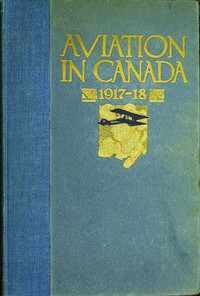
The source record for Aviation in Canada, 1917-1918 Being a Brief Account of the Work of the Royal Air Force Canada, the Aviation Department of the Imperial Munitions Board, and the Canadian — Inside the Classic measures this digital text at 45,777 words, 3 hr 20 min estimated reading time, and 9 detected text sections.
The text analysis averages about 21.4 words per sentence, while the detected sections provide another way to judge how the source is divided.
Project Gutenberg metadata also associates the work with “Airplanes,” connecting these edition facts with the source record’s subject description.
Explore this collection
These alternatives are selected using recorded categories and estimated reading time.
About 196 minutes
Architecture
45,062 recorded words. 4 minutes difference from this book's estimate.
View Gutenberg source #59233About 189 minutes
Architecture
43,413 recorded words. 11 minutes difference from this book's estimate.
View Gutenberg source #67027About 214 minutes
Architecture
49,027 recorded words. 14 minutes difference from this book's estimate.
View Gutenberg source #29904Search stored excerpts and compare books → Choose by your preferences →
Choices use stored catalog measurements. Estimates vary with reading speed. A shared category is a catalog label, not a claim that two books have the same argument or literary quality.
Search reads excerpt text stored with this catalog and links to its associated Gutenberg record. The connection is stored in the site database; this tool does not recheck that every excerpt is word-for-word identical to that external record. Excerpt search does not cover every chapter and does not verify historical publication dates.
Catalog snapshot checked: 2026-09-26. Coverage: 90 public books, 90 available source excerpts.
Calculated from edition completeness, EPUB availability, text structure and catalogue metadata. Not a user rating.
Total of 100 points, scaled to a 2.5-5.0 range. Editions with an empty description or a missing EPUB file are not scored.
Public-domain source text
The source text is kept in the dedicated reader, separate from this catalogue record and its commentary.
Compiled by Lieutenant Alan Sullivan in 1919, Aviation in Canada, 1917-1918 is an official history that documents the rapid expansion of Canada's military aviation infrastructure during the final two years of the First World War. The work focuses on three entities: the Royal Air Force Canada, the Aviation Department of the Imperial Munitions Board, and Canadian Aeroplanes Limited. Sullivan, who served in the R.A.F., presents a narrative grounded in administrative records, training statistics, and logistical details, rather than combat anecdotes. The book's catalog subjects—airplanes, the Royal Flying Corps, and military aeronautics—align closely with its content, though the excerpts reveal a stronger emphasis on bureaucratic processes and training than on aircraft design or combat operations.
The book's subtitle promises a brief account, and Sullivan delivers a tightly focused narrative that rarely strays from organizational matters. The table of contents lists chapters on headquarters staff, training, medical service, winter flying, and various schools (aeronautics, armament, gunnery). Notably absent are chapters on aerial combat or individual pilot experiences. The preface includes a disclaimer that the Air Ministry is not responsible for any statements, indicating the work's semi-official status. Sullivan's sources are described as compiled from memories of flying officers, but the text itself reads as a summary of reports and statistics, with little direct quotation. This suggests the book is a synthesis of institutional memory rather than a collection of firsthand testimonies.
The excerpts reveal a striking emphasis on the mechanics of training. At the School of Aeronautics, cadets were organized into squads that remained together throughout instruction. The school's output reached 6,171 pupils, and the curriculum evolved to include aerial navigation, machine gun instruction, and engine maintenance. Sullivan notes that engine instruction was improved by constructing running sheds at Leaside and later by using sections of aeroplane fuselages balanced for vertical adjustment. The block system introduced in October 1918 allotted specific hours to engines, navigation, wireless, rigging, and artillery observation. This focus on quantifiable training metrics—cadet numbers, flight formations, examination pass rates—reflects the administrative lens through which Sullivan viewed the brigade's achievements.
The narrative details the physical expansion of training facilities. The School of Aeronautics initially used University of Toronto buildings, then took over Wycliffe College and a remodeled hotel called Haydon House. By April 1918, cadet numbers reached 1,277, requiring another university residence. The use of the Lippincott Technical School in Toronto for engine instruction highlights collaboration with civilian institutions. Sullivan also records the formation of specialized flights for observers and aerial navigation. These details underscore the rapid scaling of Canada's aviation training system, from a small cadre to a brigade that by 1918 had a staff of 26 officers and 230 non-commissioned officers and men at the School of Aeronautics alone. The book thus serves as a logistical case study of wartime mobilization.
Readers interested in the administrative machinery behind Canada's air effort will find this compilation valuable, but those seeking combat narratives or technical aircraft specifications should look elsewhere. Sullivan's work is best approached as a primary source for understanding how a dominion government organized, funded, and expanded a military aviation branch under the pressures of war. The detailed breakdown of training hours, personnel numbers, and facility expansions offers a concrete picture of institutional growth, even if the human dimension remains largely absent.
Reading Aviation in Canada, 1917-1918, I kept thinking how every carefully logged flight depended on ground that felt so solid. That quiet trust in the earth beneath the runways reminded me of Earthquakes and other earth movements — A Closer Reading — the way John Milne writes of the ground shifting, gently, as if it, too, holds its own history. Strange, how a book about the sky leads back to the soil.
Capture what you thought, learned, and would like to remember.