About 214 minutes
Thoughts on Art and Life — Context and Discussion
Architecture
49,027 recorded words. 4 minutes difference from this book's estimate.
View Gutenberg source #29904
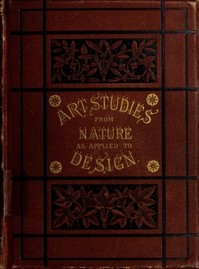
Before opening Art-Studies from Nature, as Applied to Design For the use of architects, designers, and manufacturers — Edition Insights, the edition data offers a quick orientation: 49,940 words, 3 hr 38 min estimated reading time, and 8 detected text sections.
The text analysis averages about 28.9 words per sentence, while the detected sections provide another way to judge how the source is divided.
Project Gutenberg metadata also associates the work with “Nature (Aesthetics),” connecting these edition facts with the source record’s subject description.
Explore this collection
These alternatives are selected using recorded categories and estimated reading time.
About 214 minutes
Architecture
49,027 recorded words. 4 minutes difference from this book's estimate.
View Gutenberg source #29904About 214 minutes
Architecture
49,128 recorded words. 4 minutes difference from this book's estimate.
View Gutenberg source #48391About 200 minutes
Architecture
45,777 recorded words. 18 minutes difference from this book's estimate.
View Gutenberg source #58887Search stored excerpts and compare books → Choose by your preferences →
Choices use stored catalog measurements. Estimates vary with reading speed. A shared category is a catalog label, not a claim that two books have the same argument or literary quality.
Search reads excerpt text stored with this catalog and links to its associated Gutenberg record. The connection is stored in the site database; this tool does not recheck that every excerpt is word-for-word identical to that external record. Excerpt search does not cover every chapter and does not verify historical publication dates.
Catalog snapshot checked: 2026-09-26. Coverage: 90 public books, 90 available source excerpts.
Calculated from edition completeness, EPUB availability, text structure and catalogue metadata. Not a user rating.
Total of 100 points, scaled to a 2.5-5.0 range. Editions with an empty description or a missing EPUB file are not scored.
Public-domain source text
The source text is kept in the dedicated reader, separate from this catalogue record and its commentary.
The preface immediately establishes a dual purpose: to celebrate nature as a source of beauty and to argue that such study is practical for artists and designers. The authors contrast the scientist's patient toil with the artist's pursuit of 'richest elements of beauty,' yet they insist that both derive from the same source. The opening lines already signal the book's structure—four papers by different authors—and its intended audience: architects, designers, and manufacturers. A reader should note the preface's defensive tone against those who might consider this view 'unpractical,' which frames the entire work as a justification for nature study in applied design.
The preface does more than introduce; it lays out a philosophy. The authors quote a poem—'The meanest flow'ret of the vale...'—to emphasize that even humble forms like lichen and fungi are worthy of study. This sets an expectation that the book will examine overlooked natural objects. The preface also warns that art is only 'noble' when it affords 'food for thought,' linking aesthetic pleasure to intellectual depth. For a first reader, this preface is a key to understanding why the subsequent papers focus on microscopic structures and botanical details rather than grand landscapes. It is not merely a reading guide but a manifesto for a particular approach to design education.
The middle excerpt shifts abruptly from the preface's broad claims to a meticulous description of algae. The text examines 'the development of certain cells into spores' and the 'wonderful generative processes' of propagation, but it quickly redirects to visual form: 'the contraction of the endochrome itself... adds a pleasing variation.' The authors describe specific species—Sphærozyga Berkeleyana, Spermosira Harveyana—and their color contrasts: 'translucent bluish green... relieved by the deep brown... and pale pink.' This is not pure botany; it is a designer's taxonomy of shape and color. The reader should note how the text moves from scientific description to aesthetic evaluation, always keeping design application in view.
The excerpt describes magnified transverse sections of seaweeds, such as Arthrocladia villosa and Desmarestia ligulata. The text explains how cells are 'forced into hexagons, pentagons, and other mathematical shapes' or form 'undulating tracery of the most elegant and intricate patterns.' This is the core of the book's method: taking scientific diagrams and treating them as design sources. The authors explicitly state that 'in the sections of the sea-weeds... we may expect to find... many hints and lessons.' For a first reader, these passages demonstrate how the book bridges natural history and ornamental design, using microscopy to reveal patterns that can be adapted for architecture and manufacturing.
Although the later excerpts are not fully provided, the book's subtitle—'For the use of architects, designers, and manufacturers'—and the preface's insistence on practicality indicate that each paper likely concludes with concrete applications. The algae section, for instance, ends by noting that 'these constitutional forms... constitute the entire structure of the whole tribe of sea-weeds,' implying that the patterns observed can be scaled up. A first reader should expect each paper to follow a similar arc: from general principle, through detailed observation, to design suggestion. The book is not a mere collection of nature studies but a systematic argument for why and how natural forms should inform decorative art.
Reading this book requires patience with technical botanical language, but the reward is a method for seeing design in nature's smallest details. The excerpts suggest that the authors expect readers to study the illustrations closely and to apply the principles to their own work. A first-time reader might begin with the preface to grasp the overall argument, then sample a paper's middle section to understand the analytical approach, before returning to the beginning for full context.
I remember sitting with this book, tracing algae lines like old handwriting, when it struck me how nature’s patience mirrors an artist’s. That quiet, exacting attention — I felt it once with Birket Foster, R.W.S. Sixteen examples in colour of the artist's work — Edition Insights, where each watercolor seemed to hold its breath, waiting to be seen rather than shown.
Your answers remain private and are stored only in this browser.