About 27 minutes
George Morland: Sixteen examples in colour of the artist's work — Background and Themes
Architecture
6,068 recorded words. 0 minutes difference from this book's estimate.
View Gutenberg source #37063
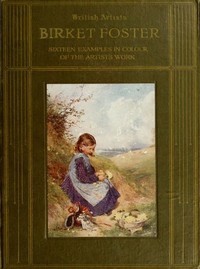
Birket Foster, R.W.S. Sixteen examples in colour of the artist's work — Edition Insights can be approached with a clearer sense of reading commitment from its source measurements: 6,012 words, 27 min estimated reading time, and 1 detected text section.
The text analysis averages about 24.2 words per sentence, while the detected sections provide another way to judge how the source is divided.
Project Gutenberg metadata also associates the work with “Foster, Myles Birket, 1825-1899,” connecting these edition facts with the source record’s subject description.
Explore this collection
These alternatives are selected using recorded categories and estimated reading time.
About 27 minutes
Architecture
6,068 recorded words. 0 minutes difference from this book's estimate.
View Gutenberg source #37063About 28 minutes
Architecture
6,250 recorded words. 1 minutes difference from this book's estimate.
View Gutenberg source #22847About 26 minutes
Architecture
5,813 recorded words. 1 minutes difference from this book's estimate.
View Gutenberg source #44539Search stored excerpts and compare books → Choose by your preferences →
Choices use stored catalog measurements. Estimates vary with reading speed. A shared category is a catalog label, not a claim that two books have the same argument or literary quality.
Search reads excerpt text stored with this catalog and links to its associated Gutenberg record. The connection is stored in the site database; this tool does not recheck that every excerpt is word-for-word identical to that external record. Excerpt search does not cover every chapter and does not verify historical publication dates.
Catalog snapshot checked: 2026-09-26. Coverage: 90 public books, 90 available source excerpts.
Calculated from edition completeness, EPUB availability, text structure and catalogue metadata. Not a user rating.
Total of 100 points, scaled to a 2.5-5.0 range. Editions with an empty description or a missing EPUB file are not scored.
Public-domain source text
The source text is kept in the dedicated reader, separate from this catalogue record and its commentary.
H. M. Cundall's introduction to Birket Foster's work opens by asserting that Foster's 'dainty water-colour paintings' appeal to the British public more than those of any other artist. The text traces how Foster's early career drawing on wood-blocks for engravers instilled a 'minuteness in detail' that persisted in his later paintings. This technical background, Cundall argues, allowed Foster to render nature with an exactness accessible even to 'the most uninitiated in art.' Yet the introduction also emphasises the 'poetic feeling' and careful composition that elevate his scenes beyond mere accuracy.
Cundall devotes considerable attention to Foster's formative years as a wood-block illustrator. The 'minuteness in detail' acquired from engraving, he writes, 'continued to pervade his paintings in later life.' This observation is supported by the list of plates, which includes subjects such as 'Gleaners,' 'Going Home,' and 'The Blackberry Gatherers'—scenes that demand precise rendering of figures, foliage, and textures. Cundall notes that Foster's early work for The Illustrated London News involved sketching watering-places, and that later in life he revisited these locations to paint 'charming little scenes' in colour. The transition from monochrome wood-engraving to full-colour watercolour is presented as a natural evolution, with the discipline of the former informing the delicacy of the latter.
The introduction identifies Surrey as the heartland of Foster's best-known work. Cundall describes 'homely scenes' from 'that picturesque part of Surrey, where he lived for many years,' and lists recurring motifs: 'sunny landscapes, with sheep roaming in the distance and with rustic children playing in the foreground,' along with 'peaceful red-brick cottages covered with thatch.' Plates such as 'A Surrey Cottage,' 'Near Godalming,' and 'Passing the Flock' exemplify this focus. Yet Cundall also notes that Foster 'wandered far afield' across England, Wales, and Scotland, with a particular fondness for the Northern counties and Northumberland, his native region. The tension between local attachment and broader travel is a thread throughout the text.
Cundall draws a direct comparison between Foster and the still-life painter William Hunt, noting that while Hunt painted fruit 'the same size as in Nature,' Foster produced 'almost miniature representations of them.' This miniature quality extends beyond still lifes: the plates include 'Loch Leven Castle,' Venetian scenes, and 'Sunset with Cattle,' all rendered with the same meticulous touch. Cundall also mentions Foster's fondness for painting children on the seashore, though he stops short of calling him a seascape artist. The introduction concludes with biographical details: Foster's illness in 1893, his move to Weybridge, and his death in 1899. His grave in Witley churchyard is marked by a Celtic cross with a simple inscription.
Cundall's text is as much a portrait of Victorian taste as of Foster himself. Readers may wish to compare the listed plates with the introduction's claims about 'poetic feeling' and 'exactness.' The sixteen colour examples—though not reproduced in this digital edition—are the core of the volume; the introduction serves as a guide to the artist's methods and subjects, not a substitute for seeing the works themselves.
There’s a particular stillness in Cundall’s words about Foster’s Surrey lanes, that careful patience in every tiny leaf. I kept thinking how that same quiet awe—of finding immense tenderness in a small, framed view—came back to me while turning through The Jewel City — A Closer Reading. Both felt like holding a moment gently, unwilling to hurry it.
Save your reaction, strongest insight, and memorable passage.