About 19 minutes
Old Fort Chartres on the Mississippi River — Inside the Classic
Architecture
4,318 recorded words. 0 minutes difference from this book's estimate.
View Gutenberg source #65371
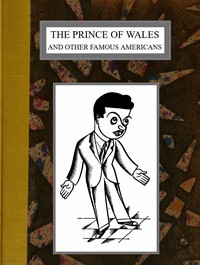
Before opening The Prince of Wales and other famous Americans — Context and Discussion, the edition data offers a quick orientation: 4,269 words, 19 min estimated reading time, and 1 detected text section.
The text analysis averages about 24.4 words per sentence, while the detected sections provide another way to judge how the source is divided.
Project Gutenberg metadata also associates the work with “Caricatures and cartoons -- United States,” connecting these edition facts with the source record’s subject description.
Explore this collection
These alternatives are selected using recorded categories and estimated reading time.
About 19 minutes
Architecture
4,318 recorded words. 0 minutes difference from this book's estimate.
View Gutenberg source #65371About 17 minutes
Architecture
3,804 recorded words. 2 minutes difference from this book's estimate.
View Gutenberg source #23450About 21 minutes
Architecture
4,655 recorded words. 2 minutes difference from this book's estimate.
View Gutenberg source #71256Search stored excerpts and compare books → Choose by your preferences →
Choices use stored catalog measurements. Estimates vary with reading speed. A shared category is a catalog label, not a claim that two books have the same argument or literary quality.
Search reads excerpt text stored with this catalog and links to its associated Gutenberg record. The connection is stored in the site database; this tool does not recheck that every excerpt is word-for-word identical to that external record. Excerpt search does not cover every chapter and does not verify historical publication dates.
Catalog snapshot checked: 2026-09-26. Coverage: 90 public books, 90 available source excerpts.
Calculated from edition completeness, EPUB availability, text structure and catalogue metadata. Not a user rating.
Total of 100 points, scaled to a 2.5-5.0 range. Editions with an empty description or a missing EPUB file are not scored.
Public-domain source text
The source text is kept in the dedicated reader, separate from this catalogue record and its commentary.
Carl Van Vechten's preface to this 1925 collection recounts the moment he first saw Covarrubias's work: a shy Mexican teenager arrived at his apartment, hugging a portfolio of caricatures. Van Vechten, initially skeptical of such appeals, was immediately convinced he was 'in the presence of an amazing talent.' The preface itself becomes a document of artistic discovery, detailing how Covarrubias—then unknown in New York—was introduced to figures like H. L. Mencken and Eva Le Gallienne. The book's title, The Prince of Wales and Other Famous Americans, signals its blend of international and domestic subjects, though the catalog subject 'Caricatures and cartoons—United States' narrows the focus to American cultural figures.
Van Vechten's preface is not a conventional introduction but a narrative of how the series began. He describes the date—September 12, 1923, the birthday of both Alfred Knopf and Henry Mencken—and the intermediary, Sherrill Schell. The young Covarrubias spoke 'quite unrecognizable English' and had been staying with Witter Bynner and D. H. Lawrence in Mexico, yet he had not drawn them because he was 'unaware that these fellows were celebrated.' This anecdote reveals Covarrubias's initial unfamiliarity with American fame, which Van Vechten corrected by arranging sittings with New York luminaries. The preface thus frames the caricatures as a collaborative project: Van Vechten's introductions made the subjects accessible, while Covarrubias's talent transformed them into art.
The preface offers a rare glimpse into the mechanics of artistic patronage in 1920s New York. Van Vechten notes that 'any person in public life is the object of at least one such appeal every week,' yet he chose to respond to Schell's call. The first caricature produced was of Van Vechten himself, delivered two days after their meeting. Covarrubias's earlier work, limited to Mexican subjects unknown in the U.S., was deemed unpublishable; the New York series was a deliberate pivot. The preface names several of the first sitters—Mencken, Waldo Frank, Avery Hopwood—and mentions Ralph Barton's 'unselfish admiration' for Covarrubias's gifts. This network of introductions and endorsements shaped the book's roster of famous Americans.
Although the excerpts contain no reproductions of the drawings, Van Vechten's description of his first encounter provides clues to Covarrubias's method. The artist made sketches 'that afternoon' and completed the finished caricature two days later—a rapid turnaround that suggests a keen eye for essential features. Van Vechten's immediate conviction of 'genius' implies that the drawings captured something beyond likeness, perhaps a psychological or social truth. The preface also notes that Covarrubias had 'nothing to show editors but caricatures of Mexicans, unknown here,' indicating that his style was already developed before the New York series. The book thus preserves a moment when a Mexican artist's perspective reframed American celebrity.
Readers should approach this book as a collaborative artifact: Van Vechten's preface supplies the backstory, while the plates themselves—not included in this text—carry the visual argument. The catalog subject 'Caricatures and cartoons—United States' accurately describes the content, but the preface reveals a more complex origin involving a Mexican immigrant's talent and a patron's network. The book is best understood as a record of how fame was constructed and caricatured in the Jazz Age.
I remember flipping through a friend’s old copy of Van Vechten’s portraits, how the bold, sharp lines made each face feel both familiar and slightly impossible. It reminded me of standing by the Lincoln Memorial, watching the rain trace gentle erosion on the stone, time’s own stylized caricature. That quiet sense of permanence fading, captured in Acid Rain and Our Nation's Capital: A Guide to Effects on Buildings and Monuments — Story, Setting & Ideas, felt just as tender.
A brief reflection can help important ideas stay with you longer.