About 141 minutes
Dürer Artist-Biographies — Reading Notes
Painting Sculpture
32,231 recorded words. 33 minutes difference from this book's estimate.
View Gutenberg source #32787
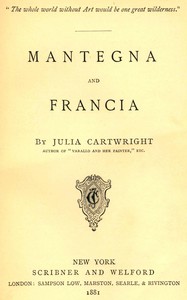
For Mantegna and Francia — Context and Discussion, the stored edition analysis reports 39,844 words, 2 hr 54 min estimated reading time, and 24 detected text sections.
The text analysis averages about 25.1 words per sentence, while the detected sections provide another way to judge how the source is divided.
Project Gutenberg metadata also associates the work with “Painters -- Italy -- Biography,” connecting these edition facts with the source record’s subject description.
Explore this collection
These alternatives are selected using recorded categories and estimated reading time.
About 141 minutes
Painting Sculpture
32,231 recorded words. 33 minutes difference from this book's estimate.
View Gutenberg source #32787About 134 minutes
Painting Sculpture
30,661 recorded words. 40 minutes difference from this book's estimate.
View Gutenberg source #38848About 233 minutes
Painting Sculpture
53,521 recorded words. 59 minutes difference from this book's estimate.
View Gutenberg source #8523Search stored excerpts and compare books → Choose by your preferences →
Choices use stored catalog measurements. Estimates vary with reading speed. A shared category is a catalog label, not a claim that two books have the same argument or literary quality.
Search reads excerpt text stored with this catalog and links to its associated Gutenberg record. The connection is stored in the site database; this tool does not recheck that every excerpt is word-for-word identical to that external record. Excerpt search does not cover every chapter and does not verify historical publication dates.
Catalog snapshot checked: 2026-09-26. Coverage: 90 public books, 90 available source excerpts.
Calculated from edition completeness, EPUB availability, text structure and catalogue metadata. Not a user rating.
Total of 100 points, scaled to a 2.5-5.0 range. Editions with an empty description or a missing EPUB file are not scored.
Public-domain source text
The source text is kept in the dedicated reader, separate from this catalogue record and its commentary.
Julia Cartwright opens her 1881 dual biography by situating Francesco Francia within a Bolognese miniaturist lineage that reaches back to Franco Bolognese, a painter mentioned by Dante in the Purgatorio. Rather than offering a generic survey, she immediately anchors her account in specific textual and visual evidence: Dante’s lines about Franco eclipsing his master Oderisio, and the surviving works of Vitale and Lippo Dalmasii. The author’s method is archival and deferential to local historians—Malvasia and Calvi are cited as the most trustworthy sources for Francia, while for Mantegna she draws on German and French scholarship by Woltmann, Baschet, and Braghirolli. This preface signals a work that values documented fact over romantic narrative.
Cartwright uses Dante’s encounter with Oderisio da Gubbio in Purgatorio XI as a historical anchor for the Bolognese school. She quotes the poet’s lines—‘the pictures which Franco now paints are fairer than his own’—to establish Franco Bolognese as a figure whose fame rests almost entirely on literary testimony, since none of his works survive. This reliance on textual evidence over visual remains is characteristic of the author’s approach. She then turns to Vitale, a pupil of Oderisio, whose 1320 ‘Madonna and Angels’ in the Bologna Gallery is described as possessing ‘a sweetness and humility of expression which approaches contemporary Sienese art.’ The phrase ‘not unworthy precursors of Francia’s Madonna’ ties the early school directly to the later master, creating a continuous lineage of devotional painting. Cartwright’s diction here is measured: she avoids claiming direct influence, instead noting resemblance.
The section on Lippo Dalmasii, nicknamed ‘Lippo delle Madonne,’ illustrates how Cartwright blends hagiographic anecdote with market observation. She reports Malvasia’s account that Lippo spent nights in prayer before painting a Virgin and received communion on the morning of the work. This detail, whether historically accurate or legendary, serves to characterize the artist’s piety as a selling point: ‘No family was considered rich in Bologna which did not possess one of his Madonnas.’ The author notes that after his death these images were ‘revered as sacred images, only uncovered on festivals.’ Cartwright does not question the veracity of Malvasia’s stories; she presents them as part of the received record. Her own voice emerges in the careful phrasing—‘so much in request that he could scarcely paint fast enough’—which hints at a commercial dynamic without moralizing.
Cartwright’s book is part of a series, ‘Illustrated Biographies of the Great Artists,’ and its format imposes a comparative structure. The preface acknowledges that ‘materials for the history of his life are far less plentiful’ for Francia than for Mantegna, a disparity that shapes the book’s balance. For Mantegna, she cites recent German and French scholarship by Woltmann, Baschet, and Braghirolli, expressing hope that ‘before long’ a complete work will appear. For Francia, she relies almost exclusively on Bolognese writers Malvasia and Calvi. This asymmetry is not hidden; it is declared openly. The author’s tone is that of a conscientious compiler, not a discoverer. She refers to her own work as ‘this little work’ and a ‘guide for the use of those’ who wish to study the painters, positioning herself as a mediator between specialist research and a general audience.
Cartwright’s prose is marked by cautious qualifiers and appeals to authority. She writes that Vitale’s pictures ‘afford us some idea of native art in these early times’—not a definitive account, but a glimpse. When describing Lippo’s virgins, she says they ‘acquired so wide a reputation as to win for him the surname “Lippo delle Madonne,”’ using the passive voice to attribute the nickname to common usage rather than her own judgment. The phrase ‘it is scarcely necessary to add the expression of our conviction’ in the preface reveals a collective authorial ‘we’ that aligns her with the series’ editors. Her diction avoids superlatives; she prefers ‘genuine and lasting pleasure’ over ‘greatest’ or ‘masterpiece.’ This restraint gives the text an air of scholarly modesty, even as it makes claims about the painters’ merits.
Readers approaching Cartwright’s biography should attend to her sources as much as her subjects. She writes as a synthesizer of existing scholarship, not a primary researcher, and her judgments are filtered through the voices of Malvasia, Woltmann, and others. The book’s value lies in its documentation of how late-nineteenth-century art history constructed the reputations of Mantegna and Francia—through archival fragments, local chronicles, and the emerging discipline of connoisseurship. For those interested in the historiography of Renaissance art, this volume offers a clear example of the period’s methods and assumptions.
I thought of you the other evening, turning through Cartwright’s quiet details on Mantegna and Francia, how she lingers on their small, human choices. It left that same gentle ache I remember from sitting with the Dürer Artist-Biographies — Reading Notes—not great drama, just the soft weight of lives lived carefully, brushstroke by brushstroke.
A brief reflection can help important ideas stay with you longer.