About 109 minutes
One Hundred Proofs That the Earth Is Not a Globe — Context and Discussion
Architecture
24,905 recorded words. 8 minutes difference from this book's estimate.
View Gutenberg source #55387
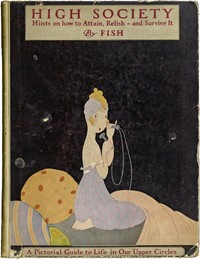
The catalog record for High society — A Reader’s Guide provides practical reading context through 23,230 words, 1 hr 41 min estimated reading time, and 6 detected text sections.
The text analysis averages about 22.4 words per sentence, while the detected sections provide another way to judge how the source is divided.
Project Gutenberg metadata also associates the work with “American wit and humor,” connecting these edition facts with the source record’s subject description.
Explore this collection
These alternatives are selected using recorded categories and estimated reading time.
About 109 minutes
Architecture
24,905 recorded words. 8 minutes difference from this book's estimate.
View Gutenberg source #55387About 93 minutes
Architecture
21,240 recorded words. 8 minutes difference from this book's estimate.
View Gutenberg source #78746About 82 minutes
Architecture
18,807 recorded words. 19 minutes difference from this book's estimate.
View Gutenberg source #39528Search stored excerpts and compare books → Choose by your preferences →
Choices use stored catalog measurements. Estimates vary with reading speed. A shared category is a catalog label, not a claim that two books have the same argument or literary quality.
Search reads excerpt text stored with this catalog and links to its associated Gutenberg record. The connection is stored in the site database; this tool does not recheck that every excerpt is word-for-word identical to that external record. Excerpt search does not cover every chapter and does not verify historical publication dates.
Catalog snapshot checked: 2026-09-26. Coverage: 90 public books, 90 available source excerpts.
Calculated from edition completeness, EPUB availability, text structure and catalogue metadata. Not a user rating.
Total of 100 points, scaled to a 2.5-5.0 range. Editions with an empty description or a missing EPUB file are not scored.
Public-domain source text
The source text is kept in the dedicated reader, separate from this catalogue record and its commentary.
The opening pages of High Society establish a gatekeeping tone that is both playful and exclusionary. The text warns that no reader “not actually in society” may pass, then lists those barred: brewers, green-grocers, minor poets, munition magnates, linen drapers, provincial actors, and cubist sculptors. The catalogue is deliberately absurd, mixing trades with artistic types to mock the very snobbery it performs. The invitation that follows, written in verse by George S. Chappell, shifts to a lighter register, urging the reader to “pirouette” in a “gay dance” of the “younger Social Set.” This tonal pivot—from stern prohibition to whimsical welcome—signals the book’s method: it satirizes high society by adopting its voice, then undercutting it with exaggeration and rhyme.
High Society credits three authors: George S. Chappell, Frank Crowninshield, and Dorothy Parker. The excerpts show distinct authorial fingerprints. Chappell’s introductory poem leans on forced rhymes and jaunty meter, ending with a self-deprecating pun on illustrator Anne Harriet Fish’s name: “a rather Fish-y look.” Crowninshield’s prose in “The Social Merry-Go-Round” adopts a detached, arch tone, describing the artist’s “faintly satiric smile” and the social world’s single law: “not to bore them.” Dorothy Parker’s contributions, though not explicitly labeled in the excerpts, are consistent with her known style—wry, compressed, and cutting. The “Bishop’s Move” entry, for instance, compares a bishop at a weekend party to “an outbreak of beri-beri,” a simile that is both precise and grotesque. The collaboration does not blend into a single voice; instead, the shifts in diction and humor create a layered satire.
The book organizes its social observations into categories, each a miniature character sketch. The hostess types are particularly well-developed. The “absent-minded hostess” ruins weekends by inviting a bishop at the last moment. The “musical hostess” captures “wild specimen[s]” from Bohemia, forcing guests to endure a “hairy conscientious objector” at the piano. The “well-meaning hostess” insists on parlor tricks, driving guests to invent excuses. Only the “vanishing hostess” is praised: she invites the right person, then disappears, leaving the “faithful family gardener” to oversee. These categories are not neutral descriptions; they are moral judgments wrapped in humor. The language is deliberately hyperbolic—beri-beri, lion’s den, “lowest forms”—to exaggerate the triviality of social grievances. The taxonomy itself mimics the pseudo-scientific classifications popular in the period, but applied to the absurd minutiae of elite entertaining.
A recurring theme in the excerpts is the effect of World War I on the servant class. The section “After-the-War Servant Problems” is introduced with the subtitle “How the Great Conflict ended the Golden Days of Service.” In “Gilding the Lily,” Mr. J. Wallingford Smith, inventor of “Smith’s Slenderizing Stays,” is shown unable to dress without “five male menials.” The war is blamed for his reduced circumstances: “poor Mr. Smith now has to adjust his jewelry without a corps of specially trained liveried attendants.” The humor is pointedly class-conscious, mocking the wealthy’s sense of deprivation. In “Why Boys Leave Home,” the Smiths watch “a battalion of their footmen, chauffeurs, butlers, valets” march away, their anguish treated as a “hideous, dreadful privation.” The satire works by inflating the loss of servants to the scale of genuine wartime tragedy, a rhetorical move that exposes the self-absorption of the social elite.
The book is described as a “many-colored whirligig,” with the artist as director. Anne Harriet Fish’s illustrations are integral to the satire, not mere decoration. The text frequently references the drawings: the “Palm Sunday” sketch shows a guest retreating to the city, with footmen “decorat[ing] the sketch with palms.” The portrait of Mr. and Mrs. Smith motoring in their “third-best Rolls-Royce” is labeled a “Portrait impression—from memory.” This interplay between image and caption creates a layered joke—the visual exaggerates what the text states, or vice versa. The book’s structure, with each page presenting a new social type or scenario, mimics the revolving motion of a merry-go-round. The reader is positioned as a spectator, watching “group after group” pass by, each more ridiculous than the last. The collaboration between writer and illustrator is tight; the humor depends on both the verbal wit and the visual caricature.
Readers approaching High Society should attend to the shifts in authorial voice and the interplay between text and image. The book is not a unified novel but a collection of sketches, poems, and cartoons that together form a satirical portrait of a specific social milieu. The humor is period-specific, relying on references to pre-war luxury and post-war dislocation. To appreciate the satire, note how the authors adopt the language of the elite only to exaggerate it into absurdity. The book rewards attention to its small details—the unexpected simile, the precise catalogue, the self-mocking rhyme.
That afternoon, the rain blurred the windows as I lingered over the satirical sketches of bustling salons, feeling oddly wistful for a world of brittle wit. The precise, sharply observed lines made me think of other meticulous hands tracing another kind of elegance — the patient, ornate beauty of old letterforms. Later, I found myself drawn to The Book of Ornamental Alphabets, Ancient and Medieval, from the Eighth Century With Numerals, including Gothic; Church Text, Large and Small; German Arabesque — Story, Setting & Ideas, its quiet flourishes a different kind of social record.
Use these questions to collect your thoughts before moving on.