About 21 minutes
Selected etchings by Piranesi, series 2 — Text and Context
Architecture
4,655 recorded words. 1 minutes difference from this book's estimate.
View Gutenberg source #71256
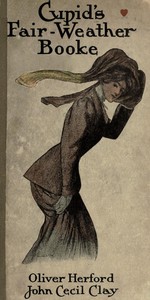
The catalog record for Cupid's Fair-Weather Booke Including an Almanack for Any Two Years (True Love Ought to Last That Long) — Reading Companion provides practical reading context through 4,896 words, 22 min estimated reading time, and 1 detected text section.
The text analysis averages about 21.6 words per sentence, while the detected sections provide another way to judge how the source is divided.
Project Gutenberg metadata also associates the work with “Love in art,” connecting these edition facts with the source record’s subject description.
Explore this collection
These alternatives are selected using recorded categories and estimated reading time.
About 21 minutes
Architecture
4,655 recorded words. 1 minutes difference from this book's estimate.
View Gutenberg source #71256About 19 minutes
Architecture
4,318 recorded words. 3 minutes difference from this book's estimate.
View Gutenberg source #65371About 19 minutes
Architecture
4,269 recorded words. 3 minutes difference from this book's estimate.
View Gutenberg source #70493Search stored excerpts and compare books → Choose by your preferences →
Choices use stored catalog measurements. Estimates vary with reading speed. A shared category is a catalog label, not a claim that two books have the same argument or literary quality.
Search reads excerpt text stored with this catalog and links to its associated Gutenberg record. The connection is stored in the site database; this tool does not recheck that every excerpt is word-for-word identical to that external record. Excerpt search does not cover every chapter and does not verify historical publication dates.
Catalog snapshot checked: 2026-09-26. Coverage: 90 public books, 90 available source excerpts.
Calculated from edition completeness, EPUB availability, text structure and catalogue metadata. Not a user rating.
Total of 100 points, scaled to a 2.5-5.0 range. Editions with an empty description or a missing EPUB file are not scored.
Public-domain source text
The source text is kept in the dedicated reader, separate from this catalogue record and its commentary.
The book presents itself as an almanac for lovers, with a title page announcing it is “Published for ye Publick Goode” and an authors’ note addressing “Good Hearticulturists.” The opening immediately establishes a horticultural metaphor: love is a crop to be cultivated, with advice on when to “set out” young plants and warnings against “late frost.” This framing shapes the reader’s expectation that the following months will offer both weather forecasts and romantic counsel.
The book’s structure is explicitly calendrical: each month gets a zodiac sign, a short poem, and a “Cupid’s Forecast.” For January, the forecast mentions “General depression, caused by Brain-storms of December” and a “wave of Good Resolutions” followed by “Ice Water.” The language blends meteorological terms with emotional states, so that a first-time reader learns to interpret each entry as both a literal weather prediction and a commentary on romantic prospects. The February entry continues this pattern, predicting “sentimental Mail Storms” on the Fourteenth. The consistency of this dual meaning across the early excerpts trains the reader to expect playful, layered readings throughout.
The authors’ note introduces the central conceit: “the success of your work depends largely upon the judgment used in selecting the time to begin.” This agricultural advice is applied to love, with terms like “Hope Vine” and “young plants” standing in for romantic endeavors. The note warns against “rushing ahead while yet conditions are too cold,” a phrase that works literally for gardening and figuratively for courtship. By the time the reader reaches the monthly forecasts, this metaphor is already active. For instance, February’s forecast mentions “Husbandmen who are cultivating matrimony,” directly linking the almanac’s advice to the reader’s own romantic life. The metaphor is not merely decorative; it provides a consistent interpretive framework.
The excerpts show a marked shift after the almanac portion. The later text consists of the Project Gutenberg license, a legal document that addresses “anyone anywhere” and uses formal, impersonal language. This contrasts sharply with the earlier sections, which speak directly to “you, Good Hearticulturists” and adopt a whimsical, advisory tone. A first-time reader encountering the full text will need to navigate this transition. The license is not part of the original 1911 book but is appended by the digital publisher. Recognizing this boundary helps the reader understand that the creative work ends before the legal text begins.
Because the excerpts are limited to the opening and the license, the full scope of the almanac—whether it covers all twelve months, how the poems and forecasts interact, and whether the Hearticulture metaphor persists—remains unknown. A first-time reader should approach the book as a hybrid: part poetry, part parody almanac, part advice manual. The early pages establish a consistent voice and conceit, but the later portions may introduce additional layers or departures. Reading with attention to the horticultural framework will likely yield the most coherent experience.
There’s something tender about the way Cupid’s Fair-Weather Booke lets love age from forecast into fine print—weather gives way to legal text, and you realize devotion is just patience with a filing system. It reminded me of old Hermann Stieffel, whose Hermann Stieffel, Soldier Artist of the West — Edition Insights showed me another kind of lasting: a hand that sketched what it couldn’t keep. Two almanacs, both honest about time’s slow work.
Create a short personal record of your experience with this book.