1

Glasgow: A Sketch Book — Edition Insights
(0 User reviews)
205
Project Gutenberg
2017
Not confirmed
Glasgow (Scotland) -- Pictorial works
Readers of public-domain and historical texts
Project Gutenberg digital edition
en
Edition facts
Words
3,251
Reading time
15 min
Text sections
1
This digital edition of Glasgow: A Sketch Book — Edition Insights is described by source-level measurements including 3,251 words, 15 min estimated reading time, and 1 detected text section.
The text analysis averages about 21.3 words per sentence, while the detected sections provide another way to judge how the source is divided.
Project Gutenberg metadata also associates the work with “Glasgow (Scotland) -- Pictorial works,” connecting these edition facts with the source record’s subject description.
Source:
Project Gutenberg record #54354
John Nisbet's 1913 sketch book presents 24 drawings of Glasgow's architecture, moving from civic squares to industrial docks, with a focus on the city's built environment.
Editorial Edition Score
4.4/5
★★★★★
★★★★★
Calculated from edition completeness, EPUB availability, text structure and catalogue metadata. Not a user rating.
How this score is calculated
- Description quality20 pts
- Title & short description10 pts
- Source metadata20 pts
- Text length15 pts
- Chapters / structure15 pts
- EPUB file integrity20 pts
Total of 100 points, scaled to a 2.5-5.0 range. Editions with an empty description or a missing EPUB file are not scored.
Edition quality
Read the Text
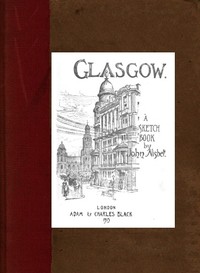
A SKETCH BOOK by John Nisbet
LONDON ADAM & CHARLES BLACK 1913
1 George Square. 2 St. Vincent Place 3 George Street--from the East. 4 Buchanan Street--from the South. 5 Trongate. 6 Royal Exchange. 7 Clyde Trust Buildings. 8 Buchanan Street from the North. 9 The Cathedral. 10 The University--from S·w·. 11 Jamaica Bridge. 12 University--Old Doorway. 13 The Clyde. 14 The Art Galleries. 15 Kelvin Bridge. 16 The Graving Dock. 17 The Pearce Institute--Govan. 18 Bothwell Street. 19 Renfield Street. 20 The Savings Bank--Ingram St. 21 Free Church College Towers. 22 Art Galleries--Sculpture Hall. 23 Sauchiehall Street. 24 University--from West.
End of the Project Gutenberg EBook of Glasgow; A Sketch-Book, by John Nisbet
John Nisbet's Glasgow: A Sketch Book, published in 1913, offers a sequence of 24 drawings that move through the city's architectural landmarks. The work opens with George Square and proceeds through commercial streets like Buchanan Street and Trongate, then shifts to the Clyde's industrial infrastructure—Jamaica Bridge, the Graving Dock—before returning to institutional buildings such as the University and Art Galleries. This structure creates a visual tour that balances civic pride with working waterfront.
A Sequence of Urban Views
The sketch book's arrangement follows a deliberate path: from the formal centre of George Square, it moves south along St. Vincent Place and George Street, then west to Buchanan Street. The Trongate and Royal Exchange anchor the commercial district, while Clyde Trust Buildings and Jamaica Bridge signal a turn toward the river. The Cathedral and University appear mid-sequence, suggesting a pause for historic and educational landmarks. Later drawings return to the Clyde—the Graving Dock and the Pearce Institute in Govan—before closing with Sauchiehall Street and a western view of the University. This circular route implies a city that can be traversed on foot, with each drawing marking a distinct stop.
Recurring Architectural Motifs
Several drawings focus on doorways, towers, and bridges, indicating Nisbet's interest in architectural details. The University's Old Doorway is singled out, as are the Free Church College Towers and the Art Galleries' Sculpture Hall. Bridges appear twice—Jamaica Bridge and Kelvin Bridge—while the Clyde itself is depicted in three separate drawings (the river, the Graving Dock, and the Pearce Institute). This repetition suggests that water and stone are the city's defining materials. The sketches of Bothwell Street and Renfield Street, both thoroughfares, reinforce a sense of urban density and verticality.
Movement Between Centre and Periphery
The sequence oscillates between central civic spaces and outlying industrial zones. After the Royal Exchange and Clyde Trust Buildings, the viewer is taken to the Cathedral (east of the centre) and the University (west). The shift to Jamaica Bridge and the Clyde introduces a working landscape of docks and shipbuilding, embodied by the Graving Dock and the Pearce Institute in Govan. The final drawings—Bothwell Street, Renfield Street, the Savings Bank, Free Church College Towers, the Sculpture Hall, Sauchiehall Street, and the University from the west—return to the city's core and its western edge, creating a loop that encompasses both commerce and labour.
The Role of the Clyde
The river Clyde is a persistent presence, appearing in three drawings: 'The Clyde,' 'Jamaica Bridge,' and 'The Graving Dock.' The Pearce Institute in Govan, a social settlement for shipyard workers, extends this industrial theme. Nisbet's inclusion of the Graving Dock—a dry dock for ship repairs—emphasises the city's maritime economy. Unlike the earlier, more ornamental views of George Square or the Royal Exchange, these river scenes are functional and unadorned. The contrast between the polished stone of the Art Galleries and the raw iron of the dock suggests a city defined by both aspiration and labour.
Readers approaching this sketch book should attend to the sequence of drawings as a curated walk. The absence of captions beyond place names leaves the images to speak for themselves. Comparing the treatment of the University—shown from two angles—with that of the Clyde reveals Nisbet's quiet commentary on Glasgow's dual identity as a centre of learning and of industry.
John Nisbet’s Glasgow sketch book always makes me think of soot on stone—that patient, unglamorous beauty of a city earning its own shape. There’s a quiet kinship with Durham: A Sketch-Book — Story, Setting & Ideas, where the same pencil seems to wait for the light to fall honestly. Both feel like old friends still standing, unhurried in their brick and shadow.
There are no reviews for this eBook.
There are no comments for this eBook.
Reader reflection
What was your reading experience?
Capture what you thought, learned, and would like to remember.
Your progress
0
/
10
2
Was reading this book enjoyable?
3
Would you encourage someone else to read it?
4
What was the reading difficulty like?
5
Did this book create an emotional response?
6
Was the book easy to understand?
7
How strong was your personal connection to the text?
8
How did the reading compare with what you expected?
9
What is the main idea you are taking away?
10