About 264 minutes
Biographical catalogue of the portraits at Weston, the seat of the Earl of Bradford — Reading Notes
Architecture
60,611 recorded words. 27 minutes difference from this book's estimate.
View Gutenberg source #64984
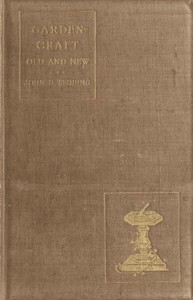
This digital edition of Garden-Craft Old and New — A Reader’s Guide is described by source-level measurements including 66,872 words, 4 hr 51 min estimated reading time, and 9 detected text sections.
The text analysis averages about 29.0 words per sentence, while the detected sections provide another way to judge how the source is divided.
Project Gutenberg metadata also associates the work with “Gardens,” connecting these edition facts with the source record’s subject description.
Explore this collection
These alternatives are selected using recorded categories and estimated reading time.
About 264 minutes
Architecture
60,611 recorded words. 27 minutes difference from this book's estimate.
View Gutenberg source #64984About 318 minutes
Architecture
73,057 recorded words. 27 minutes difference from this book's estimate.
View Gutenberg source #65107About 263 minutes
Architecture
60,472 recorded words. 28 minutes difference from this book's estimate.
View Gutenberg source #7348Search stored excerpts and compare books → Choose by your preferences →
Choices use stored catalog measurements. Estimates vary with reading speed. A shared category is a catalog label, not a claim that two books have the same argument or literary quality.
Search reads excerpt text stored with this catalog and links to its associated Gutenberg record. The connection is stored in the site database; this tool does not recheck that every excerpt is word-for-word identical to that external record. Excerpt search does not cover every chapter and does not verify historical publication dates.
Catalog snapshot checked: 2026-09-26. Coverage: 90 public books, 90 available source excerpts.
Calculated from edition completeness, EPUB availability, text structure and catalogue metadata. Not a user rating.
Total of 100 points, scaled to a 2.5-5.0 range. Editions with an empty description or a missing EPUB file are not scored.
Public-domain source text
The source text is kept in the dedicated reader, separate from this catalogue record and its commentary.
John D. Sedding, an architect who built gardens for the houses he designed, opens Garden-Craft Old and New with a self-deprecating preface borrowed from Stevenson: his book offers no 'formidable bunch of grapes' but rather 'descriptions of what he thinks a fine garden should be.' The work began as a lecture to the Art-Worker's Guild, then 'fell to pieces' into a 'garden-plaything' of loose pages. This origin shapes the book's conversational, occasionally digressive voice—Sedding writes in 'the broken leisure of a busy life,' and the text retains the feel of an extended, opinionated essay rather than a systematic treatise.
Sedding positions himself as 'advocate of old types of design,' arguing that the formal, architectural garden—with clipped yew hedges, terraces, and sundials—is superior to the so-called 'Naturalesque or Landscape style' championed by Lancelot 'Capability' Brown and his followers. He quotes Repton's claim that 'Nature was to be our only model' with evident irony, and dismisses Brown's fashion as one that 'might have been expected to endure as long as Nature should exist!' The book's central conflict is between art and nature: Sedding insists that a garden is a work of art, not a slice of wilderness. He targets the 'sham architectural features' and 'would-be artistic subterfuges' of gardens like Kent's at Stowe, where an octagon basin was 'converted into an irregular piece of water' to hide its artificiality.
Sedding enlists allies to bolster his case. He reproduces Dr. Johnson's withering assessment of Shenstone's gardening: 'Whether to plant a walk in undulating curves, and to place a bench at every turn… demand any great powers of the mind, I will not enquire.' Johnson's 'surly and sullen spectator' becomes a weapon against the landscape school's pretensions. Sedding also cites Walpole's and Addison's essays, and Pope's 'admirable chaff.' Yet he is not merely a collector of quotations; he uses them to sharpen his own argument. When Whately recommends 'a plain field or a sheep-walk' as part of a garden's embellishments, Sedding calls it evidence of a failure to understand the garden's 'function… as a refining influence in life.'
The book's nine chapters move from theory ('The Theory of a Garden') to history ('Historical and Comparative Sketch') to practical design ('The Technics of Gardening'). But the preface warns readers that the essay 'lost gravity and compactness' after its delivery, becoming a 'gardener's open letter.' This explains the shifts in pace: early chapters are dense with architectural principles, while later ones, especially 'A Plea for Savagery' and 'In Praise of Both,' adopt a more playful, dialogic tone. The inclusion of nine illustrations—plans of rosaries, tennis lawns, and sunk flower gardens—anchors the text in concrete designs, though Sedding admits he offers 'descriptions' rather than 'useful figured plans.' The result is a hybrid work: part manifesto, part historical survey, part practical guide.
Readers should approach Garden-Craft Old and New as a period piece in the debate over garden design, not a how-to manual. Sedding's voice is that of a passionate advocate, not a neutral historian; his quotations and anecdotes are weapons in a polemic. The book rewards attention to its rhetorical strategies—the way it frames the landscape school as a 'grand moment' of folly, and the formal garden as a lost art. For those interested in Victorian aesthetics or the history of landscape architecture, it offers a vivid, opinionated entry into the conversation.
I have watched John Sedding’s Garden-Craft Old and New sit unread for decades, its arguments for order and form gathering dust. Yet some evenings I find myself turning from his tidy plans to the loose, wandering hours promised in Cupid's Fair-Weather Booke Including an Almanack for Any Two Years (True Love Ought to Last That Long) — Reading Companion. Both know that a structure, however stern, only matters when something tender grows inside it.
Answer a few questions and save a private reflection on this device.