About 109 minutes
One Hundred Proofs That the Earth Is Not a Globe — Context and Discussion
Architecture
24,905 recorded words. 14 minutes difference from this book's estimate.
View Gutenberg source #55387
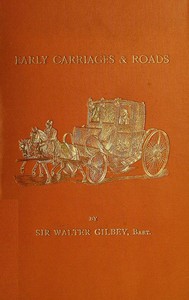
The catalog record for Early Carriages and Roads — Background and Themes provides practical reading context through 28,146 words, 2 hr 3 min estimated reading time, and 8 detected text sections.
The text analysis averages about 25.4 words per sentence, while the detected sections provide another way to judge how the source is divided.
Project Gutenberg metadata also associates the work with “Great Britain -- Social life and customs,” connecting these edition facts with the source record’s subject description.
Explore this collection
These alternatives are selected using recorded categories and estimated reading time.
About 109 minutes
Architecture
24,905 recorded words. 14 minutes difference from this book's estimate.
View Gutenberg source #55387About 101 minutes
Architecture
23,230 recorded words. 22 minutes difference from this book's estimate.
View Gutenberg source #56739About 152 minutes
Architecture
34,816 recorded words. 29 minutes difference from this book's estimate.
View Gutenberg source #68122Search stored excerpts and compare books → Choose by your preferences →
Choices use stored catalog measurements. Estimates vary with reading speed. A shared category is a catalog label, not a claim that two books have the same argument or literary quality.
Search reads excerpt text stored with this catalog and links to its associated Gutenberg record. The connection is stored in the site database; this tool does not recheck that every excerpt is word-for-word identical to that external record. Excerpt search does not cover every chapter and does not verify historical publication dates.
Catalog snapshot checked: 2026-09-26. Coverage: 90 public books, 90 available source excerpts.
Calculated from edition completeness, EPUB availability, text structure and catalogue metadata. Not a user rating.
Total of 100 points, scaled to a 2.5-5.0 range. Editions with an empty description or a missing EPUB file are not scored.
Public-domain source text
The source text is kept in the dedicated reader, separate from this catalogue record and its commentary.
Sir Walter Gilbey's Early Carriages and Roads (1903) opens by stating that wheeled conveyances 'have had an intimate relationship with the social life of English people from an early period.' Rather than a technical manual for coach-builders, the book traces the development of vehicles and roads through legal records, petitions, and eyewitness descriptions. The excerpts show a work deeply engaged with the friction between regulation and practice: licensing acts, complaints about nuisances, and the turbulent behaviour of hackney coachmen.
The excerpts reveal a persistent struggle between authorities and coachmen. An edict of 1692 noted that only 160 of about 1,000 hackney coachmen applied for licenses. The men were 'a turbulent set,' indicted for blocking streets and assaulting those who tried to move them. A 1693 Act compelled coachmen to carry fares ten miles out of London, but enforcement was lax. Five commissioners appointed to oversee licensing were dismissed for accepting bribes from tradesmen. Petitions from coachmen themselves complained of unlicensed competitors and sought incorporation as a guild. These details show that the history of carriages is inseparable from the history of urban governance and class conflict.
Gilbey quotes Mons. Misson's account of how disputes over fares were settled by boxing: 'If the coachman is soundly drubbed, that goes for payment.' Misson reports seeing the Duke of Grafton fight a coachman in the Strand. This anecdote illustrates the informal justice of the streets and the physical risks of the trade. The same source notes that London squares were railed to keep coaches from crossing them—a small detail that speaks to the tension between pedestrian space and vehicular traffic. The excerpts also show that cab driving could be lucrative: a 1710 Act increased licenses to 800, each paying 5s. weekly, and the trade remained profitable enough to attract repeated petitions and legislative attention.
The text distinguishes between types of carriages with precision. The 'shaise' or chaise is described as a different vehicle from the hackney coach, introduced from France by John Tull, son of the agriculturist Jethro Tull. In 1740 John Tull patented a sedan chair fixed on a wheel carriage for horse draught. The excerpts also mention 'hackney chairs' and 'short stages,' indicating a varied transport economy. Gilbey's method is to compile evidence from acts, petitions, and contemporary writers, letting the documents speak. The result is a work that, while focused on vehicles, constantly opens onto broader social history—the behaviour of crowds, the economics of licensing, and the physical texture of London streets before pavements.
Readers should approach Early Carriages and Roads as a compendium of primary sources stitched together by Gilbey's commentary. The book's value lies less in narrative than in the raw material it preserves: petitions, statutes, and observations that capture the lived experience of transport before the railway. The excerpts suggest that the catalog subject 'Great Britain -- Social life and customs' is well earned, but the work is best mined for its documentary fragments rather than read as a continuous history.
The rain kept me indoors with Gilbey’s old coaches, their creaking axles and muddy roads feeling oddly restful. Then, mid-chapter, my eye caught the turquoise shimmer of a different shelf entirely—Turquois mosaic art in ancient Mexico — Reading Notes. Both books speak of journeys, I suppose, just differently adorned.
A brief reflection can help important ideas stay with you longer.