About 44 minutes
Acid Rain and Our Nation's Capital: A Guide to Effects on Buildings and Monuments — Story, Setting & Ideas
Architecture
9,967 recorded words. 2 minutes difference from this book's estimate.
View Gutenberg source #57972
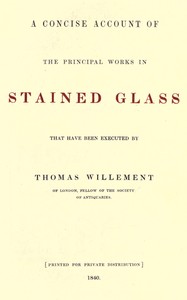
This digital edition of A concise account of the principal works in stained glass that have been executed by Thomas Willement of London, Fellow of the Society of Antiquaries — Story, Setting & Ideas is described by source-level measurements including 10,527 words, 46 min estimated reading time, and 26 detected text sections.
The text analysis averages about 14.1 words per sentence, while the detected sections provide another way to judge how the source is divided.
Project Gutenberg metadata also associates the work with “Glass painting and staining -- Great Britain,” connecting these edition facts with the source record’s subject description.
Explore this collection
These alternatives are selected using recorded categories and estimated reading time.
About 44 minutes
Architecture
9,967 recorded words. 2 minutes difference from this book's estimate.
View Gutenberg source #57972About 42 minutes
Architecture
9,543 recorded words. 4 minutes difference from this book's estimate.
View Gutenberg source #66850About 40 minutes
Architecture
9,192 recorded words. 6 minutes difference from this book's estimate.
View Gutenberg source #36066Search stored excerpts and compare books → Choose by your preferences →
Choices use stored catalog measurements. Estimates vary with reading speed. A shared category is a catalog label, not a claim that two books have the same argument or literary quality.
Search reads excerpt text stored with this catalog and links to its associated Gutenberg record. The connection is stored in the site database; this tool does not recheck that every excerpt is word-for-word identical to that external record. Excerpt search does not cover every chapter and does not verify historical publication dates.
Catalog snapshot checked: 2026-09-26. Coverage: 90 public books, 90 available source excerpts.
Calculated from edition completeness, EPUB availability, text structure and catalogue metadata. Not a user rating.
Total of 100 points, scaled to a 2.5-5.0 range. Editions with an empty description or a missing EPUB file are not scored.
Public-domain source text
The source text is kept in the dedicated reader, separate from this catalogue record and its commentary.
Thomas Willement's 1840 catalogue opens with a frontispiece engraving of the Hampton Lucy altar window, then immediately lists works by date, beginning in 1812 at Caerhays, Cornwall. The entries are terse: a location, a patron, and a description of the glass. At Caerhays, the staircase window contains 'the badges of the several Dukes of Cornwall; and other heraldic ornaments.' The catalogue is a record of commissions, not an artistic manifesto.
Willement, a Fellow of the Society of Antiquaries, printed this account for private distribution. The entries rarely exceed three sentences, yet they reveal a consistent practice: armorial bearings dominate, often arranged to show family descents or alliances. The 1819 entry for Eridge Castle includes an equestrian portrait of the Earl of Abergavenny, arranged 'in the same manner as the figure on the seal of Richard Neville, the great Earl of Warwick.' Such historical allusions recur throughout.
The catalogue's arrangement by execution date, from 1812 to 1838, allows the reader to trace Willement's career through specific commissions. The earliest entries are brief: for 1812, only two lines describe Caerhays. By 1835, the Hampton Lucy entry includes a Latin inscription and notes an engraving by John Barak Swaine. The heraldic content is paramount; nearly every entry mentions shields, arms, or badges. At Lambeth Palace (1818), an 'armorial compartment' for Archbishop Moore was presented by his family. At Charlecote Park (1835), nine large compartments show 'the descent of Sir John Lucy.' The catalogue is essentially a list of heraldic glass, with figurative subjects appearing only occasionally.
Willement's patrons were predominantly aristocrats and clergy. The catalogue names peers like the Earl of Abergavenny, the Duke of Somerset, and Earl Hardwicke, as well as baronets and esquires. Locations range from Cornwall to Northumberland, with a concentration in the Midlands and South. Many entries specify the room: 'the great hall,' 'the principal staircase,' 'the library.' At Stoneley Abbey (1836), eleven corridor windows contain 'the various alliances of the family,' presented by Lord Leigh's mother. The geography of the catalogue maps a network of country houses and churches, each with a specific heraldic program.
A notable pattern is the frequency of windows presented by donors. At Lambeth Palace (1818), the armorial compartment was 'presented by his family.' At Bridge, Kent (1837), the altar window was 'presented by the Dowager Marchioness of Conyngham.' At Wimborne Minster (1838), three lancet windows were 'presented by William John Bankes, Esq.' These gifts often commemorated a family or individual. The 1835 Hampton Lucy window includes a scroll recording that the rector, John Lucy, had it made. The catalogue thus documents not only Willement's work but also the patronage networks that funded it.
Willement's descriptions are usually sparse, but occasional details stand out. At Eridge Castle (1819), the equestrian portrait is compared to the seal of the Earl of Warwick. At Catterick Bridge (1836), five lancet windows are described as 'in foliated patterns, with coloured bands and borders.' At Stover Lodge (1838), a horizontal window is 'ornamentally arranged.' The most elaborate entry is for Hampton Lucy (1835), which includes subjects from the life of St. Peter and the benefactors' arms. These rare expansions hint at the variety of Willement's output, though the catalogue remains a concise record.
Reading this catalogue sequentially reveals the steady rhythm of Willement's practice: a stream of armorial commissions for the halls and chapels of Britain's gentry. The entries are factual, but the cumulative effect is a portrait of a craft embedded in family pride and ecclesiastical patronage. For a first reading, note how the later entries occasionally include more detail, perhaps reflecting the author's growing confidence or the increasing complexity of the work. The catalogue is best approached as a primary document of nineteenth-century stained glass, not as a narrative.
Flicking through Willement’s careful lists of heraldic windows, I remembered my grandfather’s own ledger of church visits—dates, patrons, small sketches. That same patient, almost devotional recording of light and lineage. It reminded me of how reading The Vailan or annular theory: A synopsis of Prof. I. N. Vail's argument in support of the claim that this Earth once possessed a Saturn-like system of rings — Reading Companion once felt—not as science, but as a slow, solemn attempt to hold a vanished sky in words.
Capture what you thought, learned, and would like to remember.