About 257 minutes
Historic Homes of New England — Inside the Classic
Architecture
59,006 recorded words. 18 minutes difference from this book's estimate.
View Gutenberg source #34873
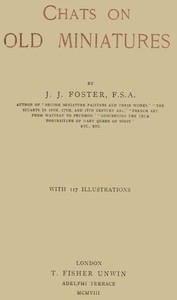
This digital edition of Chats on Old Miniatures — Context and Discussion is described by source-level measurements including 54,741 words, 3 hr 59 min estimated reading time, and 9 detected text sections.
The text analysis averages about 21.3 words per sentence, while the detected sections provide another way to judge how the source is divided.
Project Gutenberg metadata also associates the work with “Miniature painting,” connecting these edition facts with the source record’s subject description.
Explore this collection
These alternatives are selected using recorded categories and estimated reading time.
About 257 minutes
Architecture
59,006 recorded words. 18 minutes difference from this book's estimate.
View Gutenberg source #34873About 259 minutes
Architecture
59,471 recorded words. 20 minutes difference from this book's estimate.
View Gutenberg source #36297About 260 minutes
Architecture
59,696 recorded words. 21 minutes difference from this book's estimate.
View Gutenberg source #17804Search stored excerpts and compare books → Choose by your preferences →
Choices use stored catalog measurements. Estimates vary with reading speed. A shared category is a catalog label, not a claim that two books have the same argument or literary quality.
Search reads excerpt text stored with this catalog and links to its associated Gutenberg record. The connection is stored in the site database; this tool does not recheck that every excerpt is word-for-word identical to that external record. Excerpt search does not cover every chapter and does not verify historical publication dates.
Catalog snapshot checked: 2026-09-26. Coverage: 90 public books, 90 available source excerpts.
Calculated from edition completeness, EPUB availability, text structure and catalogue metadata. Not a user rating.
Total of 100 points, scaled to a 2.5-5.0 range. Editions with an empty description or a missing EPUB file are not scored.
Public-domain source text
The source text is kept in the dedicated reader, separate from this catalogue record and its commentary.
J. J. Foster opens his 1908 volume with a characteristic self-deprecation, calling the title "Chats on Old Miniatures" a "misnomer" because he has "done all the talking." This framing sets the tone for a work that blends connoisseurship with a deliberately informal, almost spoken quality. Foster addresses the reader directly, uses first-person asides, and peppers his prose with evaluative phrases such as "extremely interesting and instructive" and "lovely." His diction is that of a knowledgeable collector speaking to a fellow enthusiast, not a dry academic treatise.
Foster's preface establishes a persona of the genial expert. He thanks his publishers for including the book in a "certain well-known series" and acknowledges Miss E. M. Foster's help in proofreading. Throughout the excerpts, he uses phrases like "I may mention" and "I have only to add one word." This conversational register extends to his descriptions: he calls a Petitot portrait of Henrietta, Duchess of Orleans, "perhaps the most beautiful of all his works." Such evaluative language is typical of Foster's approach; he does not merely describe but judges, guiding the reader's taste. The effect is that of a guided tour through a private collection, with Foster as the loquacious host.
Foster's descriptions are grounded in material specifics. He notes that Petitot "generally used plates of gold or silver, seldom copper" for his enamels, and that the borders of wreaths of enamelled flowers were the work of Jules Legarré, goldsmith to the King. He also records that Bruckmann, a Swede, supplied enamel portraits "by the dozen" to the French Ministry of Foreign Affairs. These details are not mere trivia; they anchor Foster's judgments in observable fact. When discussing Lawrence Crosse, he remarks on his "fondness for blue drapery—so well shown in the Duke of Portland's Collection." The specificity of the collection and the colour choice gives the observation weight.
Foster frequently enlivens his text with anecdotes of provenance. He quotes Horace Walpole on a Charles I miniature: "I have a fine head of Charles I., for which he probably sat, as it is not like any I have seen by Van Dyck." He then traces the miniature's journey from Petitot's son, a major in the British service, to the Burdett-Coutts Collection. Such stories do more than authenticate; they create a sense of historical continuity. Foster also mentions that the portrait of Cardinal Richelieu is mounted in a "lovely chased gold and jasper snuff-box, which once belonged to the King of Saxony." These details appeal to the collector's instinct for pedigree and rarity.
Foster characterises artists by their working methods and personal quirks. Of Jean Etienne Liotard, he writes that he was "of somewhat irregular habits and uncertain methods of work," known in Paris as "le Turc" because "Oriental costumes had a fascination for him." He cites Walpole's opinion that Liotard's "likenesses were as exact as possible." For Cosway, Smart, and Humphrey, he notes their professional milestones: Cosway elected Royal Academician in 1773, Humphrey setting out for Italy with Romney, Smart made Vice-President of the Incorporated Society of Artists. These biographical markers serve as shorthand for their artistic standing, allowing Foster to build a hierarchy of reputation without lengthy analysis.
Foster's chatty yet precise style rewards readers who attend to his offhand remarks and provenance stories. His judgments are always tied to specific works, collections, or technical details, making the book a useful companion for examining miniatures in person. The reader is encouraged to look for the material clues Foster highlights: the metal support, the border work, the colour palette. His voice, though of its time, remains a clear guide to the connoisseur's eye.
That reminded me of my grandfather’s long afternoons, turning pages of his old art books, pausing on each tiny face. He loved how Foster made a painter’s life feel like a conversation. There was a similar quiet devotion in those Scottish pages, where faith’s small details became enduring portraits of courage. Annals of the persecution in Scotland — Background and Themes held that same patient reverence, a still hush over human endurance.
Answer a few questions and save a private reflection on this device.