
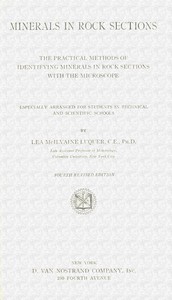
Minerals in rock sections : The practical methods of identifying minerals in…
Let's be clear: this isn't a novel. There's no protagonist, unless you count the determined scientist at their microscope. 'Minerals in Rock Sections' is a practical manual, a how-to guide from 1898. Its 'plot' is the methodical process of identifying a mineral when all you have is a sliver of it, mounted on a slide.
The Story
The book walks you through the entire investigation. It starts with how to properly prepare a rock 'section'—slicing it thin enough for light to pass through. Then, it becomes a guide to the clues. Luquer explains what to look for: the mineral's color (in plain light and polarized light), its shape, how it breaks light into colors, and how it interacts with the minerals next to it. Each property is a piece of the puzzle. The book provides tables and clear descriptions to compare your observations against, moving you from a mystery speck to a confident identification.
Why You Should Read It
What's captivating is its hands-on, problem-solving spirit. You feel like you're peering over Luquer's shoulder, learning a trade. It demystifies a complex scientific skill, breaking it into manageable steps. For anyone interested in geology's history, it shows how the field's foundational data was actually gathered—not with fancy computers, but with sharp eyes, patience, and guides like this one. It’s a reminder that science advances through precise observation and shared, practical knowledge.
Final Verdict
This book is a niche gem, but a brilliant one for the right reader. It's perfect for geology students, history of science enthusiasts, or rockhounds who want to understand the classic methods behind the science. If you've ever looked at a polished stone and wondered how experts truly know what it is, this book shows you the meticulous, almost artistic, process developed over a century ago. It's not a casual read, but for the curious mind, it’s a fascinating portal into the day-to-day work that built a science.
This text is dedicated to the public domain. Feel free to use it for personal or commercial purposes.
Paul Martin
4 months agoHigh quality edition, very readable.
Matthew Hernandez
3 months agoEnjoyed every page.
Karen Anderson
1 year agoAfter hearing about this author multiple times, it challenges the reader's perspective in an intellectual way. Definitely a 5-star read.
Michael Thompson
6 months agoI had low expectations initially, however the arguments are well-supported by credible references. I couldn't put it down.



Carol Garcia
1 month agoWow.